A long-term trend is a systematic direction of change across time. Averaging monthly CO₂ measurements by year makes the persistent upward movement easier to see without seasonal variation. section 9.1
Mauna Loa atmospheric CO₂
Yearly average atmospheric CO₂ measured at Mauna Loa from 1958 to 2001 shows a clear upward trend. Forecasting from an earlier year, such as 1975, requires using only observations available then and accounting for dependence between nearby years. section 9.1
A filter that assumes the latent state’s expected value stays constant produces flat long-range mean predictions. Such a model reacts to new observations but has no mechanism for persistent drift, making it inadequate for strongly trending processes. section 9.10
Figure 9.1 Yearly average CO₂ concentrations measured at Mauna Loa Observatory between 1958 and 2001. The time series shows an upward trend.
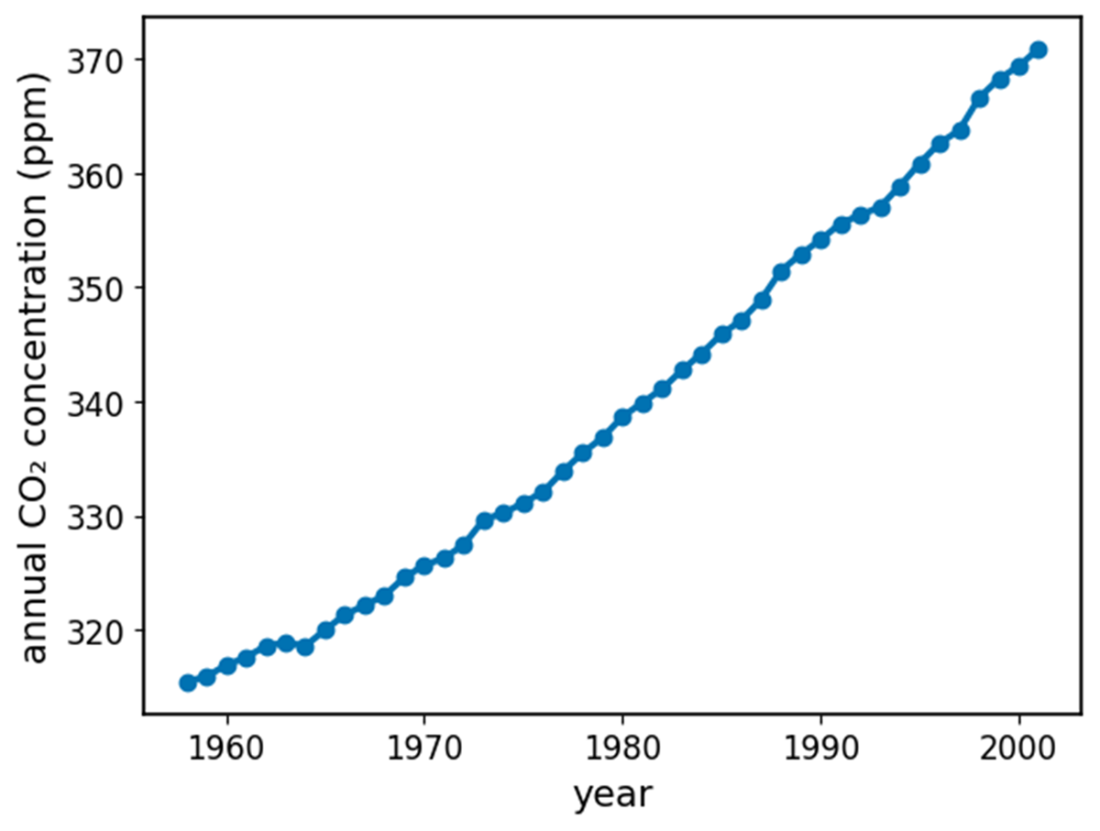
The time-series plot makes the upward direction of yearly CO₂ concentrations immediately visible. section 9.1