Lookalike audience targeting expands a valuable customer segment by using algorithms to find prospective users who share characteristics with that source audience. Marketers typically upload anonymized first-party data to a social media advertising platform, then use the resulting audience for more focused campaigns than generic advertising. section 7.2
A practical targeting pattern combines audience similarity with responsible data activation:
- Start with a high-value customer segment rather than an undifferentiated customer list. section 7.2
- Use anonymized first-party data to create the source audience on a social advertising platform. section 7.2
- Use a data clean room when matching customer or high-value audience data with publisher data, keeping consent, access monitoring, and retention controls in view. section 8.2
- Measure engagement and conversions, then refine campaigns using first-party behavioral and conversion data. section 7.2
Travel-company expansion
A travel company analyzes high-value customer data in a clean room and matches it with a publisher’s audience data to identify new users who resemble existing customers. section 8.2
Figure 8.4 A high-level secure matching process in a data clean room
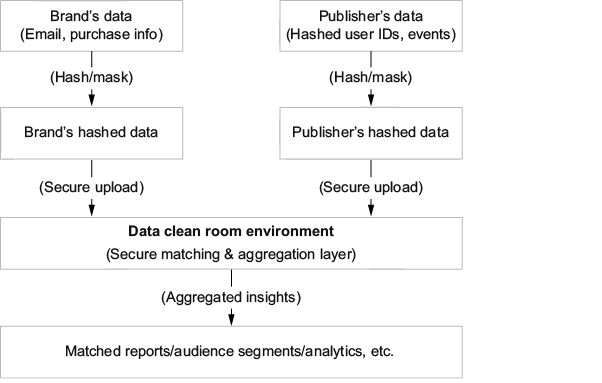
A high-level secure matching process clarifies how clean-room workflows support lookalike audience activation while keeping matching and access controls visible. section 8.2
