LoRaWAN is a low-power wide-area wireless networking protocol for connecting battery-powered sensors over long distances. It carries measurements from physical devices toward digital services; lightweight messaging protocols can then help move readings to edge and cloud systems. LoRaWAN is the network connection, not the entire data pipeline. section 1.2.1
Its main tradeoff is coverage and battery life rather than high-bandwidth transfer. LoRaWAN can transmit over 10 km while using substantially less power than Wi-Fi, making years-long battery operation possible for small sensors. Choose a sensor connection by checking gateway distance, available power, data volume and frequency, existing infrastructure, and total cost—not range alone. section 1.2.1 section 3.3.3
A hybrid home sensor network
A battery-powered flow meter on an outdoor tap sends readings over LoRaWAN. Sensors near power outlets use existing Wi-Fi instead. One gateway serves the LoRaWAN sensors, while both paths feed a common message broker. An electricity meter takes a third route: its affordable pulse counter uses Bluetooth Low Energy and requires manual data export. Device availability can therefore outweigh a preferred network design. section 3.3.3
Figure 3.6 A hybrid sensor network that uses LoRaWAN and Wi-Fi to send electronic sensor readings to a common message broker
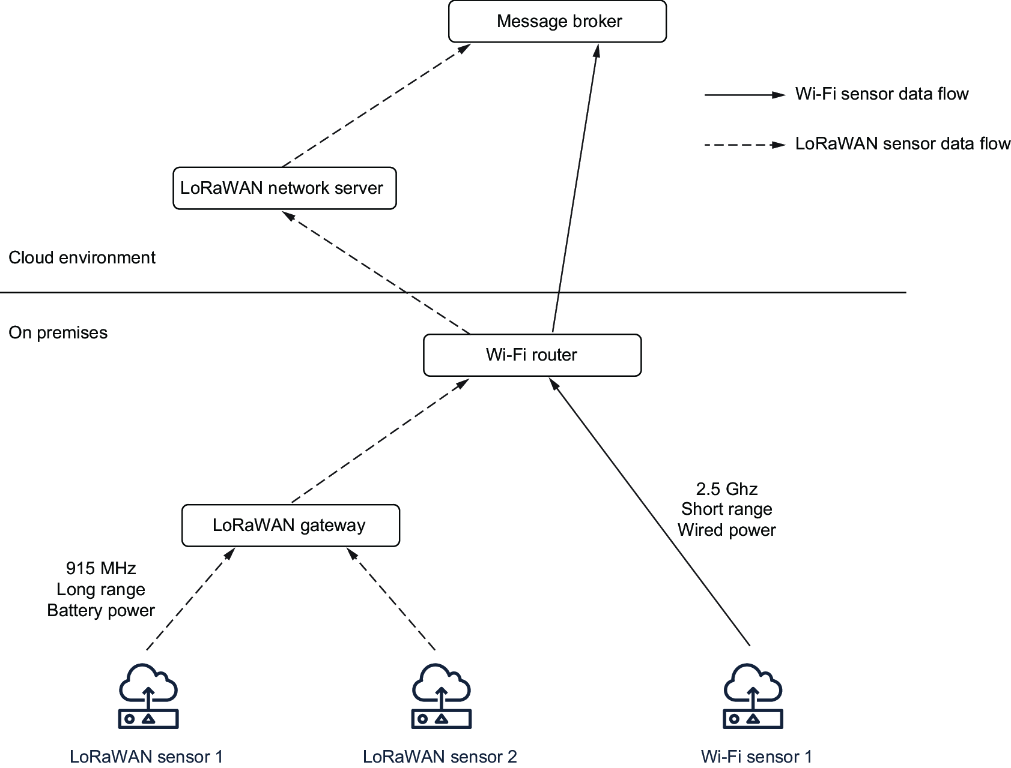
The hybrid-network diagram shows where LoRaWAN and Wi-Fi take separate paths before sensor readings reach a common message broker. section 3.3.3
Network delivery is only one part of keeping a digital twin current. Readings still need decoding, standardization, and processing; a deployed sensor fleet also needs monitoring, firmware management, and calibration. A private LoRaWAN network using a gateway and managed service is one deployment option, not a requirement for every sensor. section 3.3.3 section 3.8
