A low-level test checks a small, controlled piece of behavior rather than whether the whole application works together. Unit tests and component tests are common low-level tests: they run in memory and keep control over the things involved, without depending on files, databases, networks, or configuration. That control makes them quick to run and easy to reason about. section 10.1.2
A button alone and a button in a form
A test can create a custom button object, click it, and verify that a click event occurs. That is a lower-level unit test. A component test can instead create a form containing the button and verify the form behavior. Both remain unit tests when every dependency is controlled; the difference is the abstraction level and scope, not whether external dependencies are used. section 10.1.2
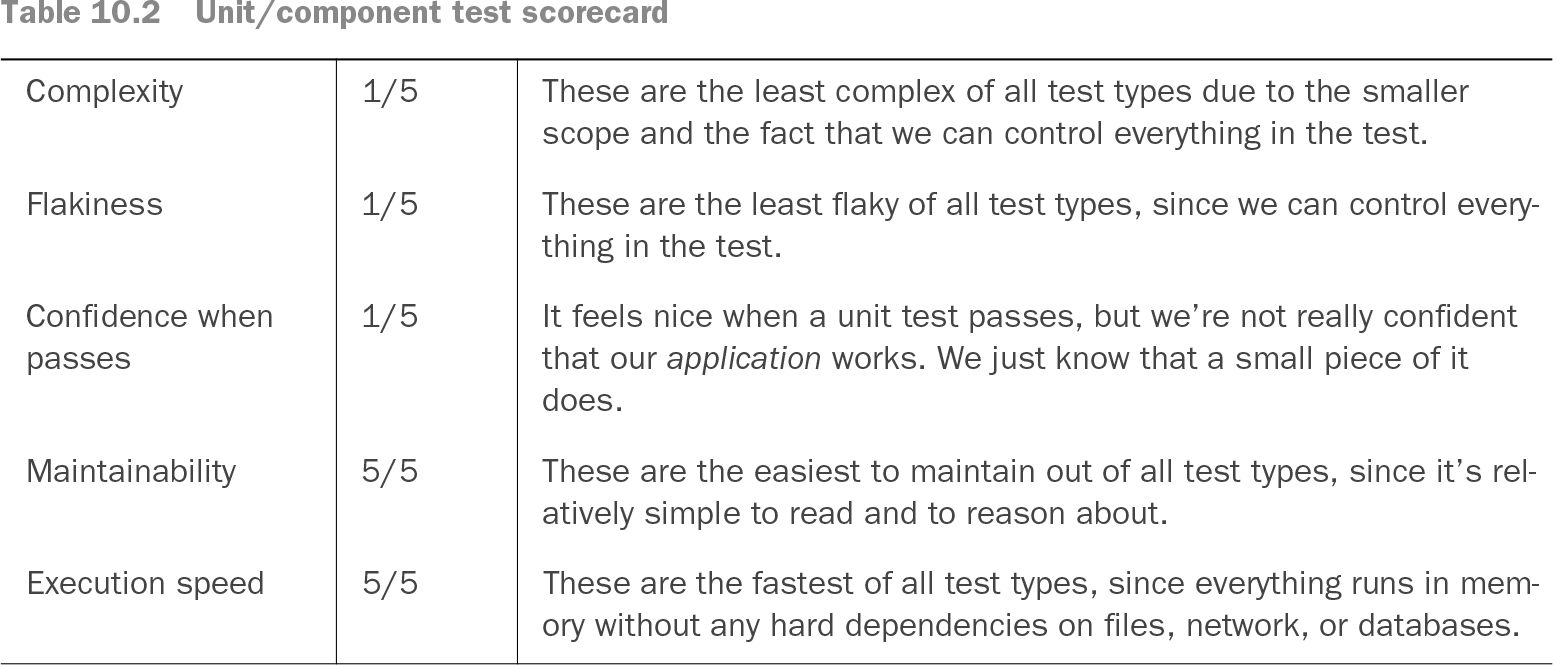
Low-level tests have strong practical advantages. Their small scope and controlled environment make them the least complex and least flaky test type, as well as the fastest to execute and easiest to maintain. A passing result, however, proves only that a small piece works. It does not provide much confidence that the application works as one integrated system. section 10.1.2
Table 10.2 Unit/component test scorecard (view table figure)
Compare the low complexity, flakiness, maintainability, execution speed, and confidence characteristics of unit and component tests. section 10.1.2
The low-level-only test antipattern appears when automated testing consists mostly or entirely of unit and component tests. Fast feedback is useful, but teams may still need manual debugging and manual testing before a release because the suite does not show whether important pieces work together. This is usually insufficient for an application, though a code library may be tested in ways closer to how its unit tests use it. section 10.2.2
Use low-level tests as part of a deliberate mix rather than as an automatic duplicate of every higher-level scenario:
- Keep the main successful user scenario at a higher level when it needs integrated confidence; test its variations at lower levels instead. section 10.3.3
- Avoid testing the same scenario at multiple layers unless there is a clear reason; repetition costs speed and maintenance. section 10.3.3
- Aim for more lower-level tests than E2E tests as a rule of thumb, while choosing levels pragmatically for each feature. section 10.3.3
- Treat integration and API tests as a middle ground, and reserve a few E2E tests for the most important functionality. section 10.5
Having both low-level and high-level tests is not enough if separate groups own them without communicating. Disconnected suites can duplicate coverage, use separate pipelines, ignore each other’s failures, and combine slow, flaky high-level tests with low-level tests that still do not provide release confidence. Shared test recipes help place scenarios deliberately and give teams a common view of what passing tests mean. section 10.2.3 section 10.3.3