A large language model can be costly to download, load into memory, and deploy. Low-rank approximation tackles part of that size problem by representing a large matrix or tensor with smaller components. It is also called low-rank factorization, low-rank decomposition, or matrix factorization. section 3.3.1 section 3.5
Figure 3.2 Example of SVD, a low-rank approximation. A is a large matrix with dimensions N and M. We can approximate it with three smaller matrices: U with dimensions M and P, Ʃ a square matrix with dimension P, and V with dimensions N and P (here we show the transpose). Usually, both P<<M and P<<N are true.
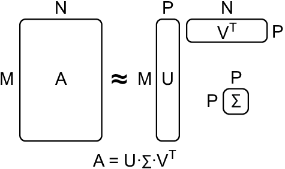
In singular value decomposition (SVD), a matrix A is approximated using U, Σ, and the transpose of V. The shared dimension P is usually much smaller than A’s dimensions; choosing a smaller P compresses more but makes the approximation less accurate. section 3.3.1
Compress a 4 × 4 matrix
A SciPy example calls `scipy.sparse.linalg.svds(matrix, k=1)` on a 4 × 4 matrix. Its returned components have shapes 4 × 1, 1, and 1 × 4: nine stored values rather than the original sixteen. Multiplying the components reconstructs a 4 × 4 approximation, not the original values exactly. section 3.3.1
SVD is one option; Tucker decomposition and canonical polyadic decomposition are also named techniques. For model compression, the practical choice is how much approximation error is acceptable for the reduction in size. Low-rank methods are also used for model adaptation through LoRA. section 3.3.1 section 3.5


