liveBook · Manning

Logical view

As explained in Kubernetes in Action, Second Edition

A logical view is an abstraction of an application that represents its Kubernetes objects and relationships without exposing the underlying infrastructure.

A logical view represents an application through its Kubernetes API objects and their relationships, hiding nodes, network topology, and physical load balancers. Unlike the physical view, it remains consistent across small development clusters and large production clusters. section 3.3.4

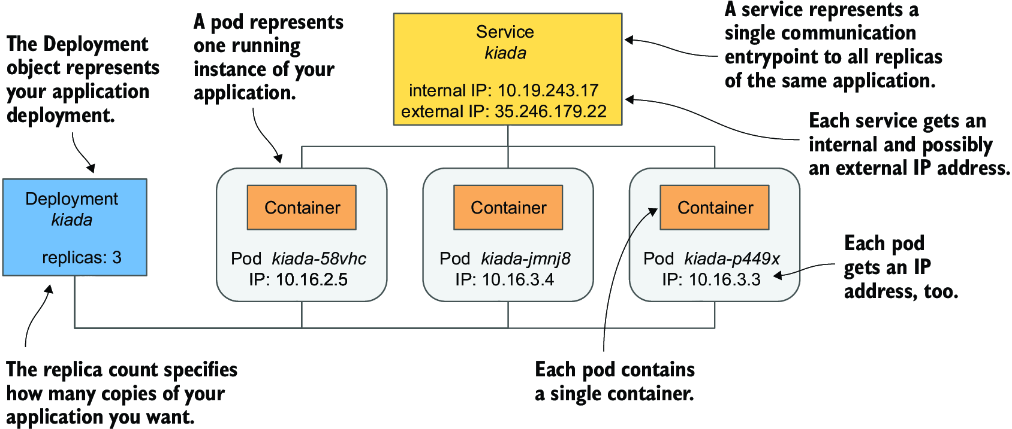
A deployed application’s logical view centers on these objects:

  • A Deployment represents the application deployment, specifying its container image and desired replica count. section 3.3.4
  • Each application replica is represented by a Pod object created automatically from the Deployment. section 3.3.4
  • A manually created Service supports the deployed application alongside the Deployment and Pods. section 3.3.4
Figure 3.13 Your deployed application consists of a Deployment, several pods, and a service.
figure

Trace how a Deployment, its Pods, and a Service form the application’s logical object relationship. section 3.3.4

How Kubernetes in Action, Second Edition covers it

How deep it goes
Explains the Deployment–Pod–Service relationship and defers additional intermediate objects to later treatment.
Examples
Uses a deployed application containing one Deployment, automatically created Pods, and a manually created Service.
What you can do after
Evaluate an application through its Kubernetes objects without needing to inspect the underlying cluster infrastructure.
How it connects
Connects Kubernetes API objects with Deployments, Pods, Services, replicas, and the physical view.

Related concepts

This explainer was generated by Manning's knowledge graph from the text of Kubernetes in Action, Second Edition. The section links point to the parts of the book it draws on.