liveBook · Manning

Machine-learning-assisted optimization

As explained in Optimization Algorithms: AI techniques for design, planning, and control problems

An optimization approach in which an algorithm repeatedly consults a learned model to make decisions during its search.

Machine-learning-assisted optimization repeatedly consults one learned model during an optimization algorithm’s search, using the current algorithm state to guide decisions. section 11.5

The learned model can influence different optimization decisions:

  • Parameterize gradient descent, simulated annealing, genetic algorithms, particle swarm optimization, or ant colony optimization. section 11.5
  • Make repeated, same-kind decisions throughout the search, rather than supplying information only once. section 11.5

DL-assisted heuristic tree search

A heuristic tree search uses deep neural networks to decide which branches to explore and how to bound nodes. section 11.5

Figure 11.14 Machine learning (ML) for combinatorial optimization (CO) problems
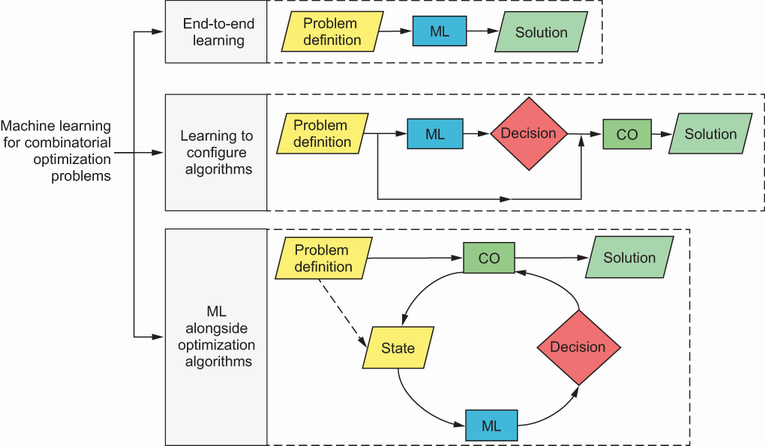
A visual taxonomy of machine learning approaches for combinatorial optimization. section 11.5

How Optimization Algorithms: AI techniques for design, planning, and control problems covers it

How deep it goes
Defines repeated model consultation and lists parameter examples, but stops short of implementation or training details.
Examples
Uses algorithm parameters and DL-assisted heuristic tree search as examples of machine-learning-assisted decisions.
What you can do after
Evaluate whether a learned model supplies parameters or repeatedly guides decisions within an optimization algorithm.
How it connects
Connects combinatorial optimization with heuristic search, deep neural networks, gradient descent, simulated annealing, genetic algorithms, PSO, and ACO.

This explainer was generated by Manning's knowledge graph from the text of Optimization Algorithms: AI techniques for design, planning, and control problems. The section links point to the parts of the book it draws on.