Machine learning infrastructure is the foundation for developing, deploying, orchestrating, and operating reliable ML systems. It connects experimentation, data preparation, training, validation, serving, monitoring, and explainability into a production-oriented workflow. section 1.0 section 1.5
A practical platform typically combines:
- Kubernetes as the infrastructure foundation, with Kubeflow providing the open-source ML platform and Kubeflow Pipelines providing orchestration. section 1.2.2 section 1.3
- Jupyter Notebooks for interactive work, followed by automated pipelines for repeatable execution. section 1.3
- MLflow for experiment tracking and model registry, preserving results, dependencies, and deployable model artifacts. section 1.5 section 4.0
- Feast for registering and storing curated features needed during both training and serving. section 1.3 section 4.0
From experimentation to production
A tabular-data project can explore datasets and candidate models, track experiments in MLflow, register the selected model and its dependencies, store engineered features in Feast, and automate the resulting workflow with pipelines. The same platform supports image-based OCR and RAG-powered documentation systems. section 1.4 section 1.5 section 4.0
Figure 1.4 The mental map of an ML setup, detailing the project flow from planning to deployment and the tools typically involved in the process
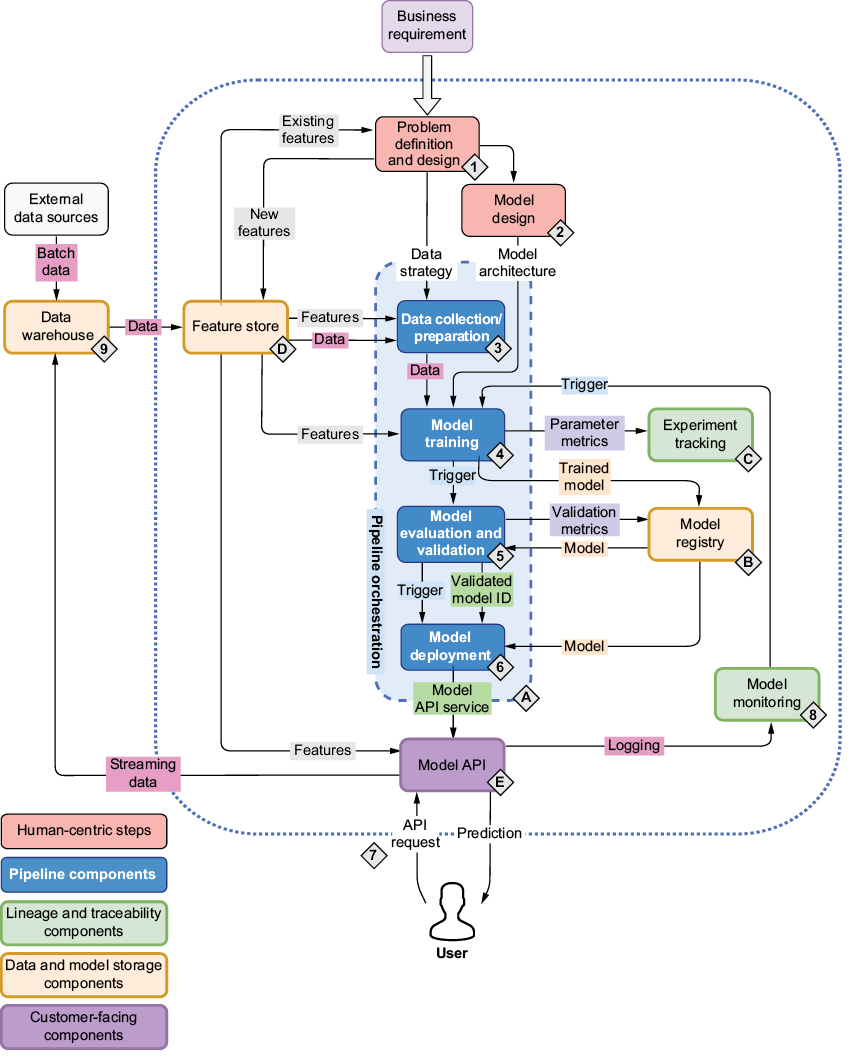
Use the mental map to trace how planning, data, infrastructure, orchestration, and deployment fit together across an ML workflow. section 1.3

