Cancer describes a malignant tumor: harmful abnormal tissue that can be difficult to distinguish from healthy anatomy in medical images. section 11.4.1
In a CT scan, cancer may occupy an extremely small fraction of the data. Even when a tumor exists, up to 99.9999% of voxels may not be cancer, making detection from images especially subtle. section 11.4.1
Finding one nodule
One CT scan contains roughly 1,000 structures that may look like tumors to an untrained eye, while a specialist identifies exactly one as a nodule. A close-up multislice crop and a malignant nodule illustrate why location and visual differences matter. section 11.4.1
Figure 11.5 A CT scan with approximately 1,000 structures that look like tumors to the untrained eye. Exactly one has been identified as a nodule when reviewed by a human specialist. The rest are normal anatomical structures, such as blood vessels, lesions, and other nonproblematic lumps.
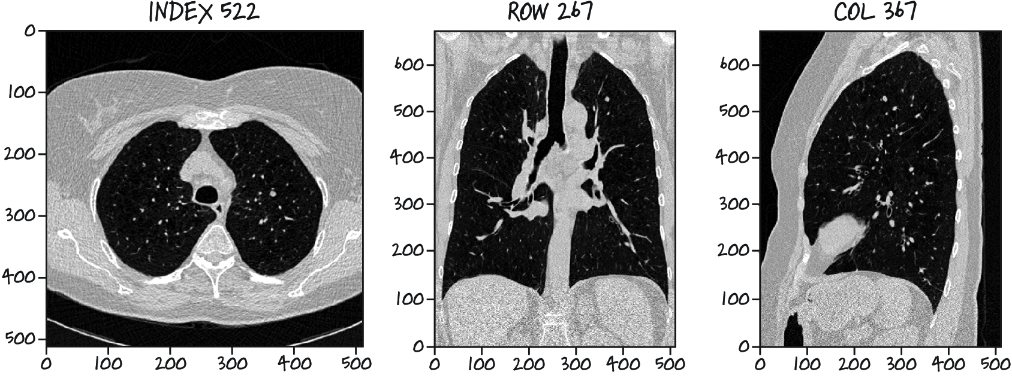
Use the figure to compare many tumor-like structures with the single nodule identified by a specialist. section 11.4.1
