A management VLAN carries remote-management traffic for network devices instead of regular user traffic. A switch commonly uses that VLAN’s SVI as its management IP address, keeping management traffic isolated for security. section 5.2.1
Any Layer 3 interface can potentially provide management access, but routers commonly use loopbacks for stable addresses, while switches commonly use an SVI in the management VLAN. section 5.2.1
Management SVI and gateway
SW1(config)# interface vlan 1 SW1(config-if)# ip address 10.0.0.2 255.255.255.0 SW1(config)# ip default-gateway 10.0.0.1 SW1(config)# do show ip interface brief Vlan1 10.0.0.2 YES manual up up SW1(config)# do show ip default-gateway 10.0.0.1 The SVI supplies the switch’s management address; the default gateway enables access beyond its local subnet. section 5.2.1
Figure 21.1 This chapter’s topology. WLC1 controls AP1, an LWAP. SW1 functions as a DHCP server, NTP server, and the default gateway for all subnets. AP1 tunnels client traffic to WLC1, which translates their 802.11 frames to Ethernet frames.
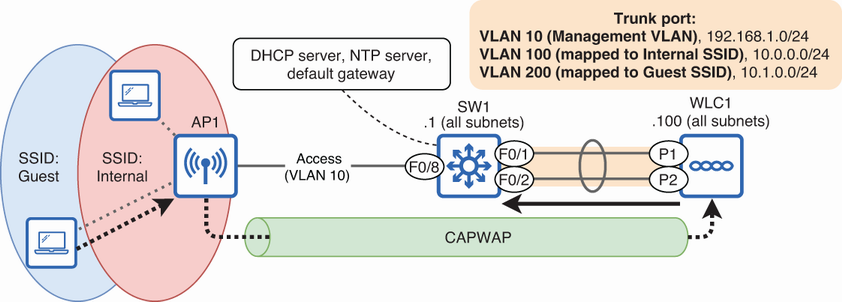
Use the topology to distinguish the dedicated management VLAN from WLAN client VLANs and to see its use by CAPWAP tunnels between the AP and WLC. section 21.1
