A manifold mesh is a triangle mesh whose edges have at most two adjacent triangles and whose triangles form a consistently surface-like structure. In 3D, one manifold mesh models a single surface. This property matters when converting smooth CAD surfaces into triangles for 3D printing, game programming, design automation, and image processing. section 1.0 section 2.2.2
Use these adjacency rules to reason about a mesh:
- Treat each triangle as having up to three neighboring triangles, one across each edge. section 2.2.2
- Allow an edge to have no more than two adjacent triangles; a boundary edge may have only one. section 2.2.2
- Reject degenerate triangles during topology checks: needles and caps have zero area and can disrupt who-touches-whom relationships. section 2.2.2
- Remember that manifold topology does not guarantee high-quality triangles; printable meshes still require quality assessment. section 1.0 section 2.2.2
Triangle ABC
Triangle ABC can neighbor ADB across AB, BEC across BC, and CFA across CA. Edge AB therefore has two adjacent triangles, while boundary edge AD has only one. This local adjacency pattern illustrates how a triangle mesh is organized as a manifold triangle mesh. section 2.2.2
Figure 1.1 Left to right: A model made of smooth surfaces, the same model made of triangles, and the model made of stacked 2D contours
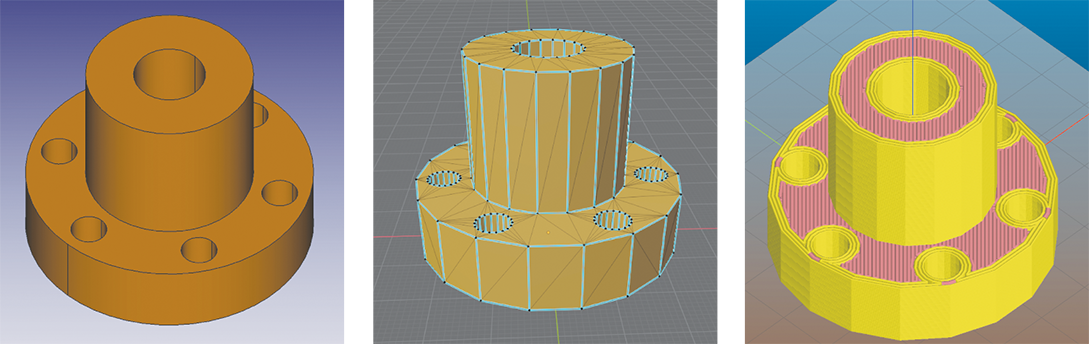
Trace a model from smooth CAD surfaces to triangles and finally to stacked 2D contours, the stages preceding 3D printing. section 1.0