Manual failover deliberately transfers database service to a secondary system through operator action. It supports disaster recovery, but it is not high availability: high availability requires automatic failover. section 13.1
Avoid these operational mistakes:
- Mistake: treating a redundant server in another data center as automatic high availability. A multisubnet failover cluster can support cross-site recovery while still requiring a deliberate failover decision. section 13.1
- Mistake: switching to asynchronous commit for performance without accepting the availability trade-off. Asynchronous replication can improve ETL throughput, but it requires manual failover and may not prevent data loss. section 13.4
Two-site disaster recovery
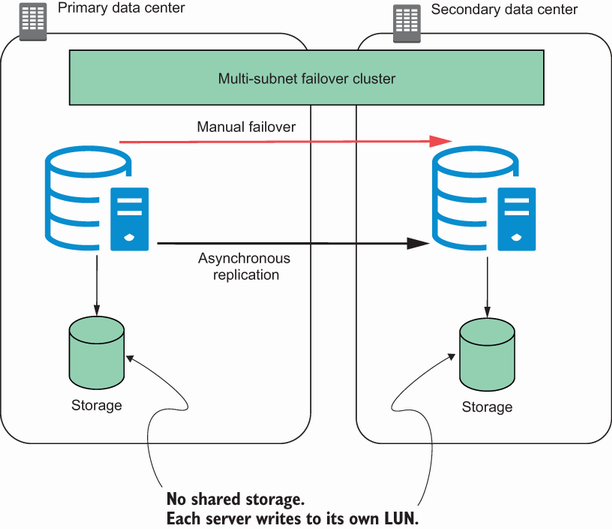
A primary data center fails during a power outage. The DBA brings service up in a second data center from the redundant system or latest backup, then performs the manual failover. This restores service, but recovery depends on operator action and the chosen replication or backup method. section 13.1
Figure 13.2 DR topology with availability groups providing manual failover between sites
Compare the two-site disaster-recovery topology with a single-site topology that provides automatic failover. section 13.1
