liveBook · Manning

Market manipulation fraud

As explained in Financial AI in Practice

Fraudulent activity intended to deceive market participants by improperly influencing financial-market prices or trading.

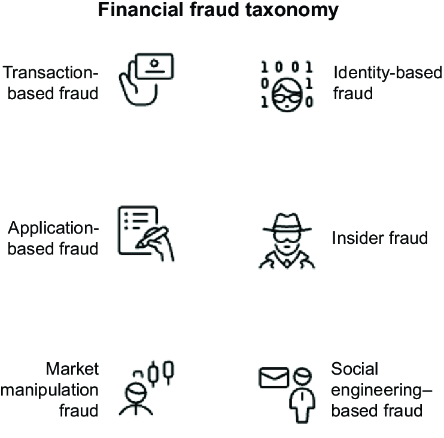
Market manipulation fraud deceives the broader financial market through schemes such as artificial price inflation, Ponzi schemes, or trading on nonpublic corporate information. It differs from employee fraud that directly misappropriates an institution’s funds. section 7.2

Figure 7.2 A structured typology of financial fraud. This framework organizes fraud into six primary categories based on the core attack vector, such as exploiting a transaction, compromising an identity, or deceiving a person. This structured view is crucial for developing specific and effective AI-driven countermeasures for each type of threat.
figure

See how market manipulation fits into a typology of financial fraud categories organized by attack vector. section 7.2

How Financial AI in Practice covers it

How deep it goes
Defines the category and names examples, without detailing detection methods or implementation.
Examples
Names pump-and-dump schemes, Ponzi schemes, and trading on nonpublic corporate information.
What you can do after
Understand how this fraud category differs from employee fraud and identify its named examples.
How it connects
Connects market manipulation fraud with financial fraud, Ponzi schemes, pump-and-dump schemes, and insider trading.

This explainer was generated by Manning's knowledge graph from the text of Financial AI in Practice. The section links point to the parts of the book it draws on.