Market positioning frames a product against alternatives by identifying the specific trade-off it makes, what it sacrifices, and the distinctive value it gains for a particular customer. It answers more than “what does this product do?”: it explains why a target user chooses it instead of a rival. section 5.2 section 5.4
Reverse-engineer positioning with three increasingly demanding questions:
- Define the product in one sentence, including the customer, the pain it solves, and the distinctive promise. section 5.2
- Compare it with three or four rivals across dimensions that genuinely divide the field rather than generic features. section 5.4
- Identify the structural trade-off an incumbent cannot copy without damaging its existing business, then verify that claim against the code and product surface. section 5.2 section 5.4
Cal.com versus Calendly
A feature checklist misses the strategic divide. Cal.com emphasizes an open-source, white-label, API-first platform with embedding, developer APIs, and OAuth, while Calendly emphasizes a branded booking experience. Cal.com therefore accepts a smaller visible consumer surface in exchange for a deeper developer platform. That trade-off is defensible because Calendly cannot simply remove its brand-led model and copy the same position without undermining its existing business. section 5.4
Figure 5.6 Cal.com and Calendly as two icebergs, each with a different product strategy. Cal.com has a small visible tip (a booking link) supported by a large, deep base of developer features: an embed system, a platform API, white-label branding, and an OAuth layer. Calendly's iceberg is the reverse: a large, branded surface with a much smaller platform underneath.
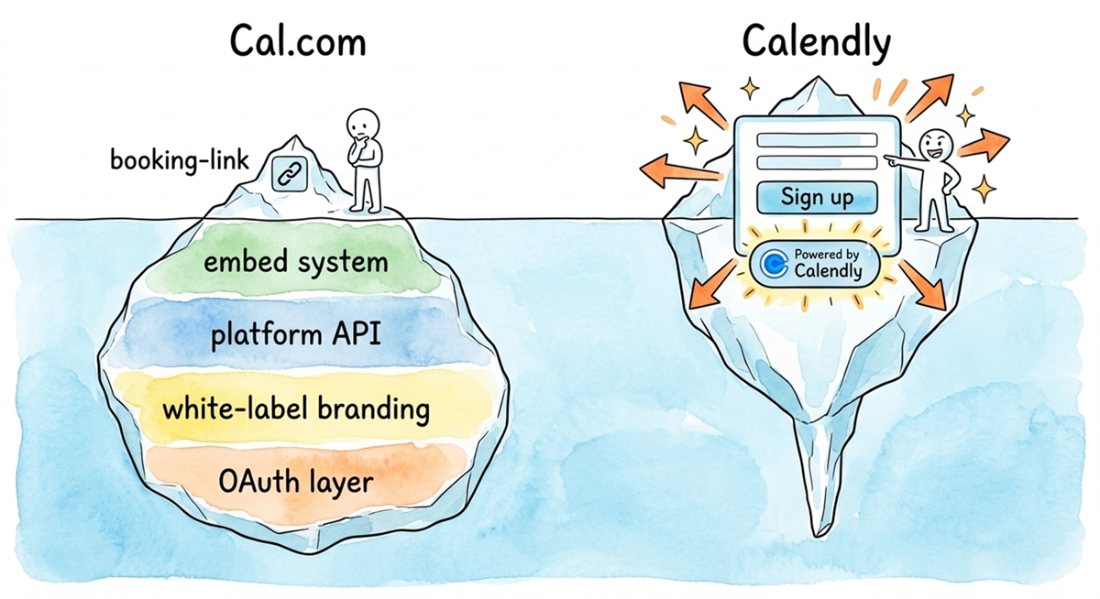
Use the iceberg comparison to separate a product’s visible feature from the deeper capabilities and business choices that support its position. section 5.4

