Marketing technology is the software and related services that help organizations collect, manage, analyze, and activate marketing data and interactions. It has become a foundation for growth as privacy constraints, channel proliferation, and demand for personalization make first-party data increasingly important. section 4.0 section 4.1
A useful decision model is to ask how a solution supports three connected jobs: collecting first-party data, managing it, and activating it in marketing experiences. The right choice depends less on a tool’s feature list than on the organization’s capabilities, use cases, and trade-offs. section 4.0 section 4.1
Evaluate marketing technology through these practical lenses:
- Collect first-party data that the organization can use as third-party cookie tracking becomes less dependable and privacy scrutiny increases. section 4.1
- Manage data through an appropriate architecture, such as a marketing data lakehouse supported by a composable customer data platform. section 4.0
- Activate insights across expanding channels, including email, direct mail, mobile notifications, chat applications, paid social, and advertising platforms. section 4.1
- Compare alternatives by matching capabilities to priority use cases rather than assuming that one vendor does everything well. section 4.0
Personalizing a customer interaction
A marketing team can use lifecycle stage, purchase history, discount sensitivity, product-category propensity, and touchpoint history to shape targeting and messaging. The technology matters because those insights must be managed and delivered across the channels where customers engage. section 4.1
Figure 4.1 Components of modern marketing technology solutions for first-party data: collect, manage, activate
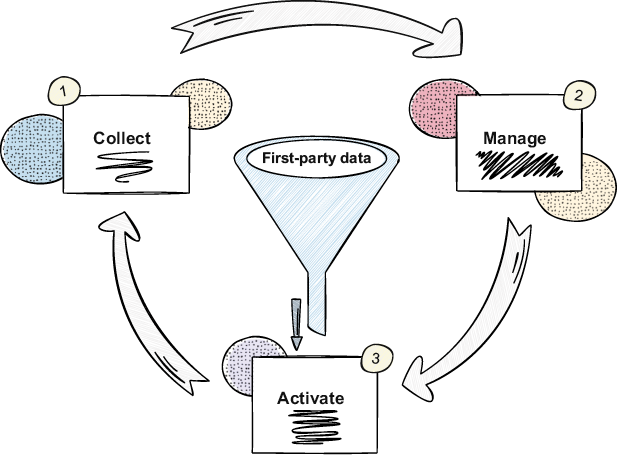
Use the figure to compare the three-part architecture of modern first-party-data marketing technology: collect, manage, and activate. section 4.1
