A Markov decision process (MDP) models decisions whose consequences unfold over time. An agent chooses an action in a state, receives a reward, and moves to a new state. The current state and action determine the probability distribution of that next state; an action need not produce the same outcome every time. section 12.1.1 section 12.1.2
Choosing a commute
Suppose driving to work takes 50 minutes in light traffic, 1 hour 7 minutes in medium traffic, or 2 hours in heavy traffic, with probabilities of 30%, 50%, and 20%. Biking has a more predictable estimate of 3 hours 16 minutes. The choice illustrates why planning must account for possible outcomes, not just a single travel-time estimate. section 12.1.1
To describe an agent’s interaction with an MDP, identify:
- The states and permissible actions: what the environment is like and what the agent can do. section 12.1.2
- The transition probabilities and rewards: what may happen after an action and what feedback the agent receives. section 12.1.2
- The policy: the strategy mapping states to actions, either deterministically or through action probabilities. section 12.1.2
In reinforcement learning, the agent tries actions and uses their rewards to improve a policy for expected cumulative reward. This differs from a multi-armed bandit problem: MDP actions affect future states, so later consequences matter. If the agent can observe only part of the environment’s state, a partially observable Markov decision process is the more appropriate model. section 12.1 section 12.1.2
Figure 12.3 An agent learns through interaction with the environment.
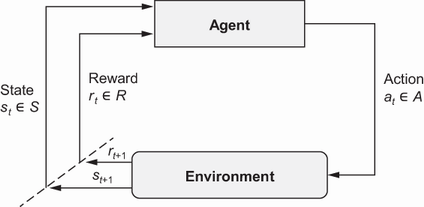
Follow the agent–environment loop to see how a chosen action leads to a reward and a new state. section 12.1.2
For a sequential optimization problem, framing states, actions, and rewards turns a search for good decisions into a search for a policy. Routing and dispatch are application areas. Whether the learner has a model of transition dynamics and rewards distinguishes model-based from model-free reinforcement learning. section 12.2 section 12.7



