When conditional-independence evidence is used to recover a causal graph, it may identify several DAGs rather than one. A Markov equivalence class groups DAGs with the same d-separation relationships. The true causal DAG is one candidate among them, so observational data alone generally cannot determine every edge direction. section 4.6.3 section 6.2.2
A partially directed acyclic graph (PDAG) can represent the class compactly: directed edges record shared orientations, while undirected edges mark directions on which class members disagree. Dependence and independence usually reveal adjacency but not direction; colliders provide an important exception. section 4.6.3
Collider-based orientation
For a structure T → E ← L, observing T and L as independent but dependent after conditioning on E supports a collider at E. By contrast, evidence of dependence for an A–T edge alone does not establish its direction. This distinction limits what a discovery algorithm can claim from observational data. section 4.6.3
Figure 4.24 Supposing the DAG on the left is the ground truth DAG, the (wrong) DAG on the right is in the same Markov equivalence class. The PDAG in the middle represents the equivalence class, where undirected edges represent edges where members disagree on direction.
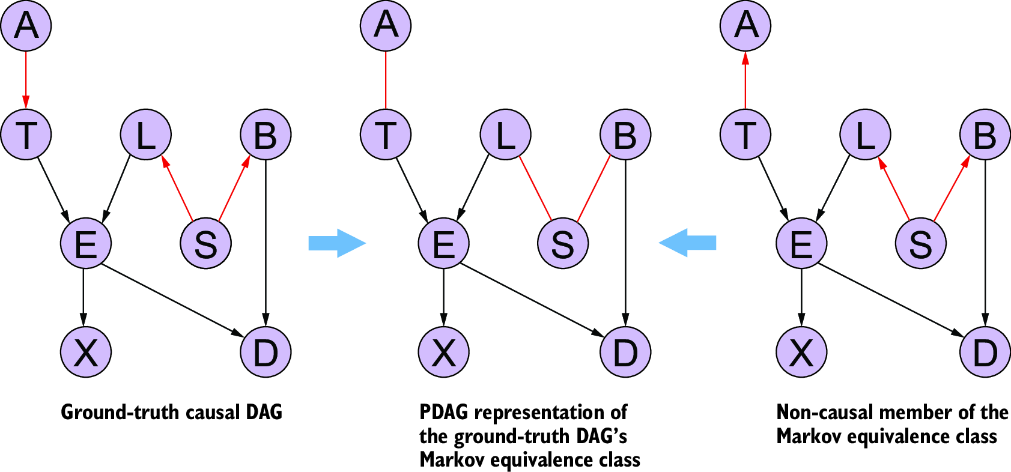
Compare a ground-truth DAG, an alternative DAG in the same equivalence class, and the class-level PDAG with undirected uncertain edges. section 4.6.3
