A Markov random field (MRF) represents a joint distribution with an undirected graph: nodes are random variables, and edges encode conditional independence. Neighboring variables interact through potentials, making the graph structure part of the probability model. section 3.3
The Ising model specializes this structure to binary states on a grid. Positive coupling favors equal neighboring states, creating a smoothness prior that is useful for recovering an underlying image from noisy observations. section 3.3
For image denoising, the model combines:
- Binary latent pixels xi ∈ {−1, +1} with noisy Gaussian observations yi. section 3.3
- Edge potentials Ψ(xs, xt) = exp{xs J xt}, where J > 0 favors matching neighboring states. section 3.3
- Mean-field variational inference, which approximates the joint posterior with a fully factored q(x) and updates each variable using neighboring means. section 3.3
Figure 3.5 Mean field VI for Ising model pseudo-code
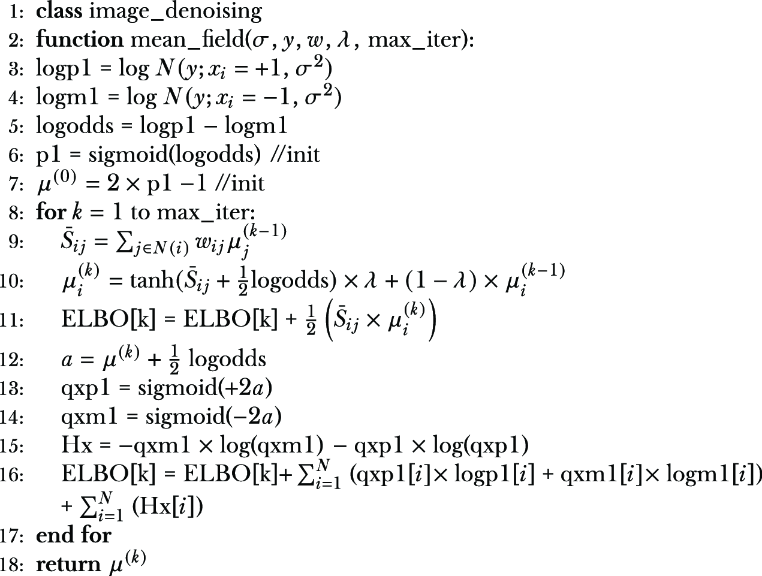
Use the pseudo-code to follow iterative mean-field inference for Ising-model image denoising. section 3.3
Denoising a binary image
Start with a two-dimensional grid of noisy pixel observations, then infer each latent pixel from its observation and the expected states of its neighbors. Repeating the updates recovers a smoother image. section 3.3
