MATH-500 is a curated evaluation set of 500 problems sampled from the original MATH dataset. It supplies a practical, repeatable workload for testing reasoning models without the cost of running the full dataset. section 3.8
Use MATH-500 when evaluation needs:
- A meaningful but manageable benchmark for repeated experiments. section 3.8
- A held-out reference set separated from a later training subset. section 3.8
- Challenging multistep problems suited to symbolic verification rather than simpler datasets such as GSM8K. section 3.8
Loading and grading the set
Load the test split from a reproducible local JSON copy or from the Hugging Face Hub. Each record includes a problem, solution, answer, and level; the complete split contains 500 entries. Apply answer extraction, normalization, and SymPy-based equivalence checking before grading model predictions. section 3.8 section 3.10
Figure 3.9 Loading the evaluation dataset. We completed steps 2-6 (generate, extract, normalize, verify, and grade answers) in the previous sections; the two remaining steps are to load the full dataset (step 7) and apply the same procedure across all the problems to evaluate the model (step 8).
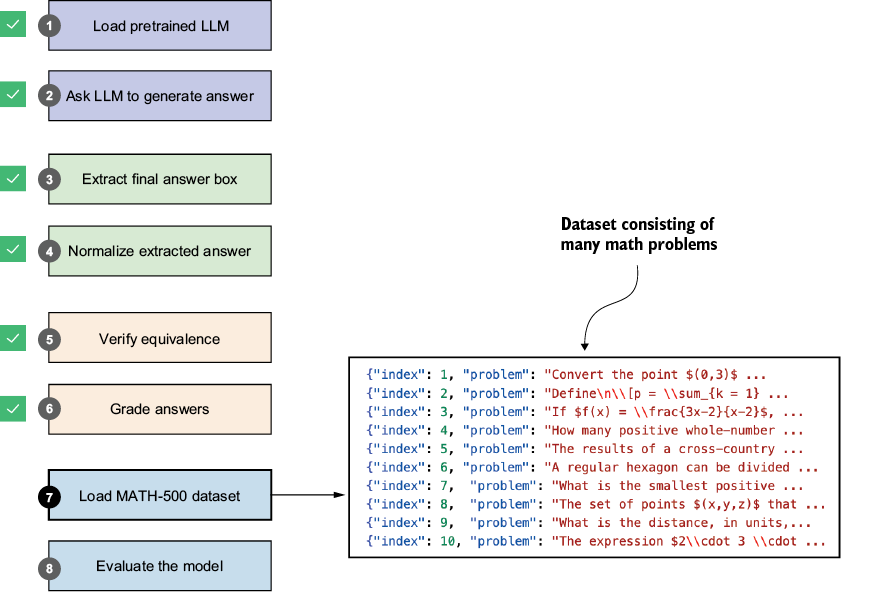
Trace MATH-500’s position in the evaluation workflow: load the dataset, run generation and verification across every problem, then calculate model performance. section 3.8
