Matrix algebra studies tables of numbers through defined operations such as addition, multiplication, and inversion. In applied geometry, it provides a compact way to stack transformations, construct curves through points, and find plane intersections. section 2.0 section 2.5
A matrix behaves like a two-dimensional vector with its own rules. Multiplying a matrix by a vector can represent a geometric transformation, turning algebraic operations into tools for manipulating space. section 2.5.3
The most useful connections are practical:
- Compose rotations, scalings, and other linear transformations by multiplying their matrices. section 2.5.1 section 4.2.1
- Recover an inverse transformation by computing an inverse matrix, and use the identity matrix for the unchanged space. section 4.2.1
- Recognize that matrix multiplication is not commutative, so changing the order of operations can change the result. section 2.5.1
Recovering a linear transformation
Given two input points and their transformed destinations, define unknown matrix entries and solve the four resulting equations with SymPy. The solution supplies the matrix coefficients, provided the input points are suitable for determining them.
Figure 4.11 Three examples of linear transformations in Euclidean space. You can’t transform (0, 0) into anything else.
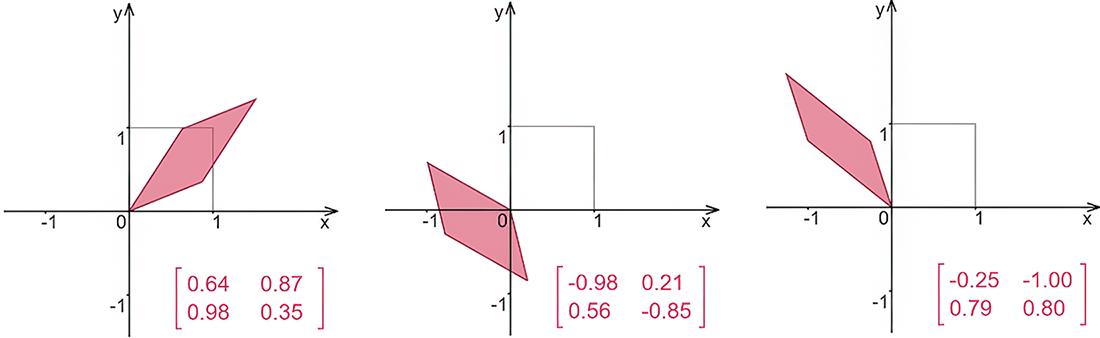
Use the figure to see three linear transformations and the key limitation that the origin cannot move under a linear transformation. section 4.2.1
