Matrix factorization decomposes a user-item interaction matrix into a user matrix and an item matrix. Their lower-dimensional values represent latent factors inferred from clicks, purchases, ratings, or other positive interactions, making hidden preferences and item similarities easier to generalize. section 4.2.3 section 9.3.1
Let R represent observed preferences, U represent users across latent factors, and I represent items across those factors. The product U · I should approximate R. Multiplying corresponding user and item factor values and summing them produces a predicted preference, including for an originally empty matrix cell. section 9.3.1
A collaborative-filtering pipeline can use matrix factorization to:
- Compress many sparse interaction signals into a smaller set of meaningful latent dimensions. section 4.2.3
- Infer preferences for items that a user has not interacted with directly. section 9.3.1
- Match documents or products through latent attributes associated with shared user interests. section 4.2.3
Movie and product patterns
Purchase histories can reveal groups without exposing product descriptions. Users who buy superhero films may induce factors related to action, Marvel or DC properties, or adult content; other users may induce animated, Disney/Pixar, or child-friendly factors. Similarly, appliance purchases can reveal a color preference, while electronics purchases can separate entertainment systems from smartphone accessories. section 9.3.1
Figure 9.7 Matrix factorization. The user-item matrix R is decomposed into two matrices, a user matrix U and an item matrix I. The product of these two matrices (U . I) should be as close as possible to the original user-item matrix R.
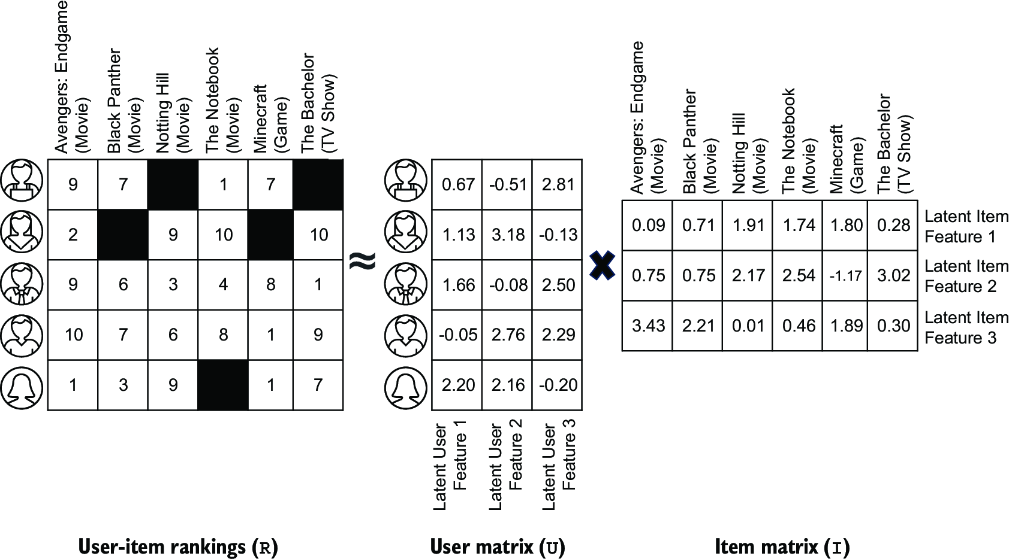
Use the decomposition diagram to inspect how the original interaction matrix becomes user and item factor matrices. section 9.3.1

