The maturity journey is a four-stage framework for assessing how a team manages prompts and choosing a practical next step. It evaluates both how prompts are stored, changed, and shared and what the team can see about their state and history. These capabilities develop together: mature visibility depends on mature management. section 11.2
The stages describe increasing management sophistication, not a mandatory upgrade path:
- Stage 1 — Inline: a baseline with no prompt-management infrastructure. section 11.2
- Stage 2 — Config files. section 11.8
- Stage 3 — Prompt store. section 11.8
- Stage 4 — Dedicated prompt management system (PMS). section 11.8
Choose a level that fits the team’s needs: teams may remain well served at stage 2 or 3 for an extended period. The prompt lifecycle—draft, test, approve, deploy, observe, improve, retire—applies at every stage. section 11.2 section 11.8
Figure 11.1 The prompt management maturity journey
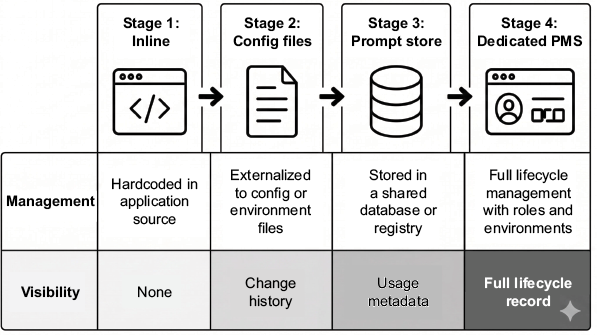
Use the four-stage diagram to orient a team’s maturity assessment. section 11.2
