liveBook · Manning

Maximization step

As explained in Data Without Labels

The maximization step of expectation-maximization updates model parameters using the latent-variable estimates from the expectation step.

The maximization step, or M step, updates each Gaussian’s mean, covariance, and density using the soft assignments calculated during the expectation step. section 5.6.1

The update uses probability-weighted calculations:

  • Compute each covariance by weighting points according to their probability of belonging to Gaussian j. section 5.6.1
  • Compute each mean as the probability-weighted mean of the points assigned to Gaussian j. section 5.6.1
  • Compute each density by summing the probabilities for Gaussian j and dividing by the total number of points. section 5.6.1
  • Repeat the expectation and maximization steps until the model converges and the log-likelihood is maximized. section 5.6.1
(5.11)
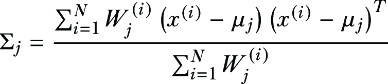
figure

Inspect the covariance update formula alongside the corresponding mean, density, and probability equations. section 5.6.1

How Data Without Labels covers it

How deep it goes
Derives weighted covariance, mean, and density updates, but defers mathematical proofs and detailed Python implementation.
Examples
Uses equations for soft assignments, covariance, probability-weighted means, and Gaussian densities.
What it assumes
Assumes familiarity with the expectation step and probability assignments while comparing the update intuition with k-means means.
What you can do after
Evaluate how EM recalculates Gaussian parameters and determines convergence through log-likelihood maximization.
How it connects
Connects expectation steps, soft assignments, Gaussian mixtures, k-means clustering, covariance, and log-likelihood.

Related concepts

This explainer was generated by Manning's knowledge graph from the text of Data Without Labels. The section links point to the parts of the book it draws on.