Maximum flow asks how much can travel through a capacitated directed network from a source s to a sink t. Edge capacities limit flow, and every intermediate vertex must redistribute exactly the amount it receives. The objective is to route flow so that the sink receives as much as possible. section 18.4.1
Model the problem with these ingredients:
- Represent the network as a directed, weighted graph; treat edge weights as capacities. section 18.4.1
- Assign each edge a flow that cannot exceed its capacity. section 18.4.1
- Conserve flow at intermediate vertices: total outbound flow equals total inbound flow. section 18.4.1
- Choose competing routes carefully when downstream capacity makes some outgoing edges more valuable than others. section 18.4.1
- Treat candidate assignments as optimization solutions; genetic algorithms can search for near-optimal flows. section 18.4 section 18.4.1
Routing through a bottleneck
In a hydraulic network, edges represent pipes and capacities represent maximum liquid volumes. If vertex D can receive at most 5 units but can send 6, its outbound flow is still limited by its inbound flow. When F can send only 1 unit to the sink, routing D’s flow toward G may increase the total reaching t. section 18.4.1
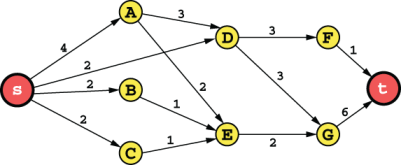
Use the network diagram to inspect the vertices, capacities, source, sink, and a maximum flow of 6. section 18.4.1
