An address block is a contiguous range of IP addresses that can represent one network or be divided into smaller networks called subnets. CIDR notation expresses its prefix length, such as /24, /25, or /28. section 11.1
Figure 11.1 The 192.168.1.0/24 address block (network) divided into smaller subnets. With a /24 prefix length, it is one subnet of 256 addresses. Using a /25 prefix length allows the block to be divided into two subnets of 128 addresses each. /26 allows for 4 subnets of 64 addresses each. /27 allows for 8 subnets of 32 addresses each. /28 allows for 16 subnets of 16 addresses each.
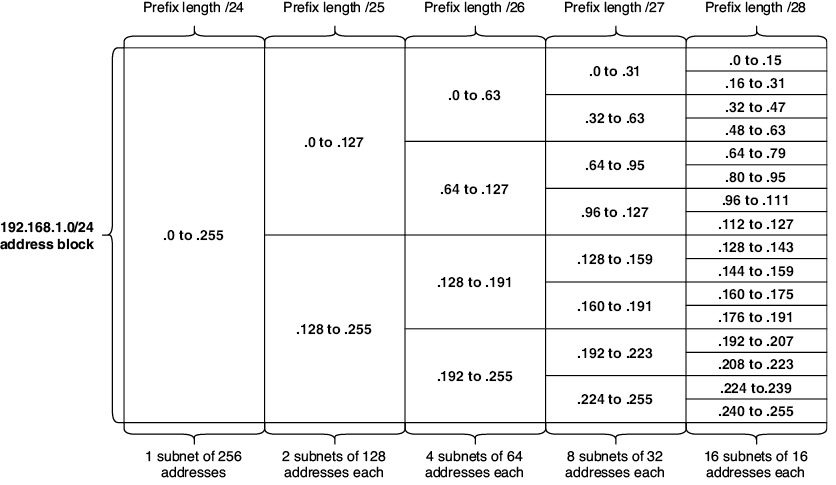
A 192.168.1.0/24 block contains 256 addresses; extending the prefix divides it into more subnets with fewer addresses each. section 11.1
Subnetting an address block follows a predictable trade-off:
- Borrowing one host bit doubles the number of subnets and halves the addresses in each subnet. section 11.5
- FLSM creates equal-sized subnets, while VLSM creates different-sized subnets for differing network requirements. section 11.5
- A practical allocation assigns the largest subnet first and leaves space for future growth. section 11.5
Toronto LAN A
A LAN requiring 122 host addresses needs seven host bits because 2⁷ − 2 provides 126 usable addresses. Borrowing one bit from 10.89.100.0/24 produces 10.89.100.0/25. section 11.3.1
