liveBook · Manning

MCP integration

As explained in Vibe Engineering

A pattern in which build-system information and capabilities are exposed to an AI agent through the Model Context Protocol.

MCP integration exposes build-system information and capabilities to an AI agent. It addresses the friction of static AGENTS.md files becoming stale as packages and workspace relationships change. section 10.2.5

A pragmatic adoption path distinguishes the available workaround from the desired integration:

  • Derive AGENTS.md from the build graph nightly to keep workspace guidance current. section 10.2.5
  • Treat live MCP integration as a future step when tooling can support the repository's polyglot stack. section 10.2.5
  • Evaluate the integration alongside agent capabilities for workspace exploration, code generation, task execution, and failure diagnosis. section 10.2.5
Figure 10.3 Build Metadata Becomes a Live Context Layer.
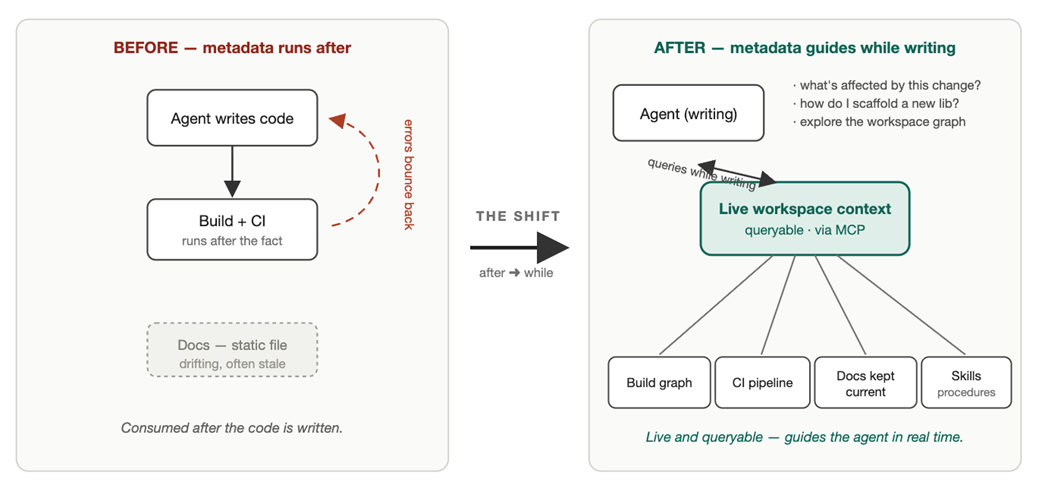
Shows build metadata becoming a live context layer for an AI agent. section 10.2.5

How Vibe Engineering covers it

How deep it goes
Contrasts static documentation with live integration but stops short of implementation details because polyglot tooling remains immature.
Examples
Uses nightly AGENTS.md generation as a workaround and identifies self-healing CI as a related direction.
What it assumes
Assumes familiarity with monorepos, build graphs, AGENTS.md, and AI-agent workspace navigation.
What you can do after
Evaluate live build metadata against static documentation while accounting for repository language mix and tooling maturity.
How it connects
Links build graphs, static documentation, workspace exploration, code generation, task execution, and self-healing CI.

Related concepts

This explainer was generated by Manning's knowledge graph from the text of Vibe Engineering. The section links point to the parts of the book it draws on.