The MCP memory server gives a cognitive agent persistent long-term memory through a local knowledge graph. It runs locally, needs no external database or embedding service, and persists its state in a JSON file. section 10.2.8
Think of the knowledge graph as structured institutional memory rather than a flat interaction log:
- Entities represent primary nodes, such as problem types. section 10.2.8
- Observations attach discrete information to entities, such as successful strategies or outcomes. section 10.2.8
- Relations connect entities with directed links, including related problems, useful tool combinations, and known failure modes. section 10.2.8
The memory module makes these primitives active in the cognitive cycle. Before planning, it retrieves relevant entities and observations; after evaluation, it records the result; when strategies transfer across problem types, it builds relations. section 10.2.8
Minimal local configuration
Configure the server as an MCP server launched with npx and @modelcontextprotocol/server-memory. A memory agent can then use search_nodes for proactive retrieval, create_entities for new problem types, and add_observations for strategies and outcomes.
Figure 10.7 The memory module’s three behaviors layered on the MCP memory server
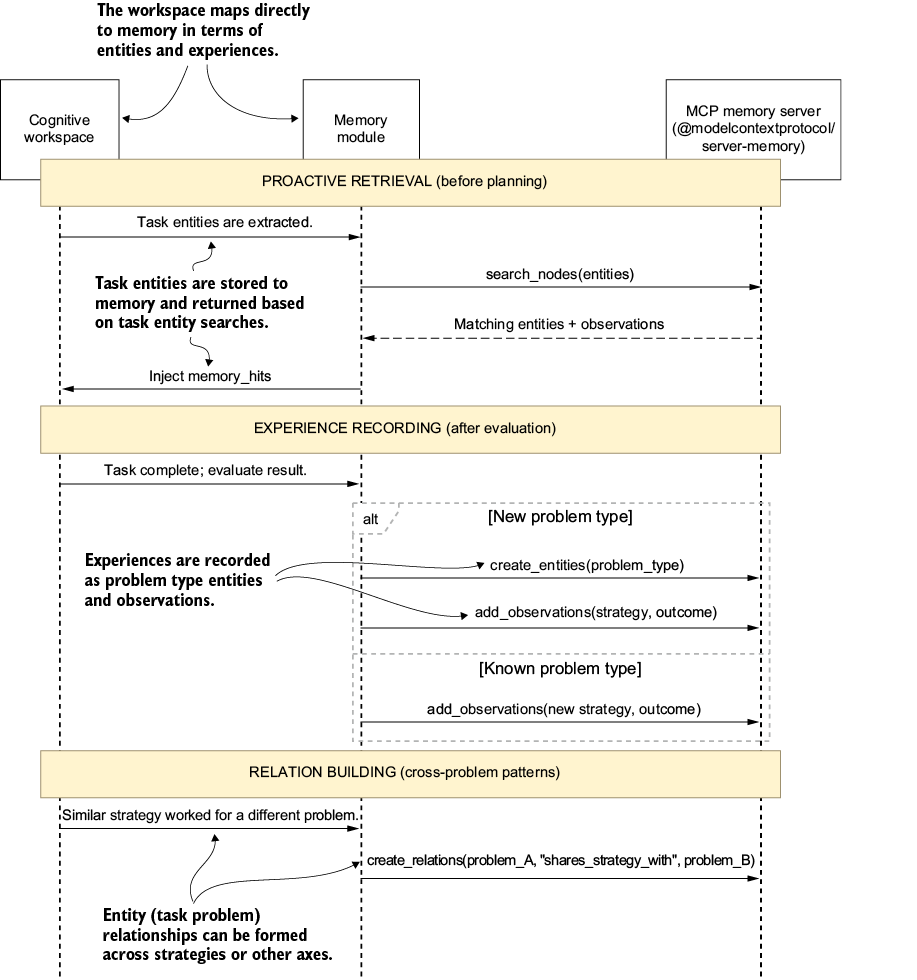
Inspect the layered flow from the MCP knowledge graph to proactive retrieval, experience recording, and relation building. section 10.2.8
