Mean power is the average power drawn over a measurement interval. For edge workloads, it is a sustained operating constraint: continuous power above a phone’s roughly 4–6 W thermal budget can cause latency to fall as the device throttles. section 11.1
A 30-second steady-state window is used to compare mean power across configurations. Treat the reading as one axis of a deployment budget alongside user-visible latency; a fast cold start does not establish that a workload can run sustainably. section 11.1.1 section 11.6
Device-specific tradeoffs
For EfficientNet-Lite0, the M3’s best configuration runs at 0.36 ms and 6.3 W, while the Pixel’s runs at 4.09 ms and 1.75 W. The faster result draws more power; which configuration fits depends on the deployment’s power budget. section 11.1
Figure 11.1 Cross-modal design space on MacBook Air M3 (laptop) and Google Pixel 10 Pro (phone). Marker shape encodes modality (circle = vision, triangle = audio, square = LLM). Twelve points populate the chart. Five M3 vision variants sit at 4.4–6.6 W, two M3 audio variants at 5.7–6.7 W, Pixel vision at 1.75 W, Pixel audio at 3.33 W, three Pixel LLM points at 5.51 W. The iPhone 16 is absent. iOS exposes no third-party API for instantaneous power (MetricKit reports daily-aggregated CPU and GPU time, not a milliwatt figure at the cadence this axis needs). M3 LLM is also absent. MLX publishes neither TTFT nor power telemetry, so the cell cannot land on either axis. Latency is p50 for vision and audio; TTFT for LLM. Power is powermetrics on macOS and BatteryManager on Android, both over a 30 s window.
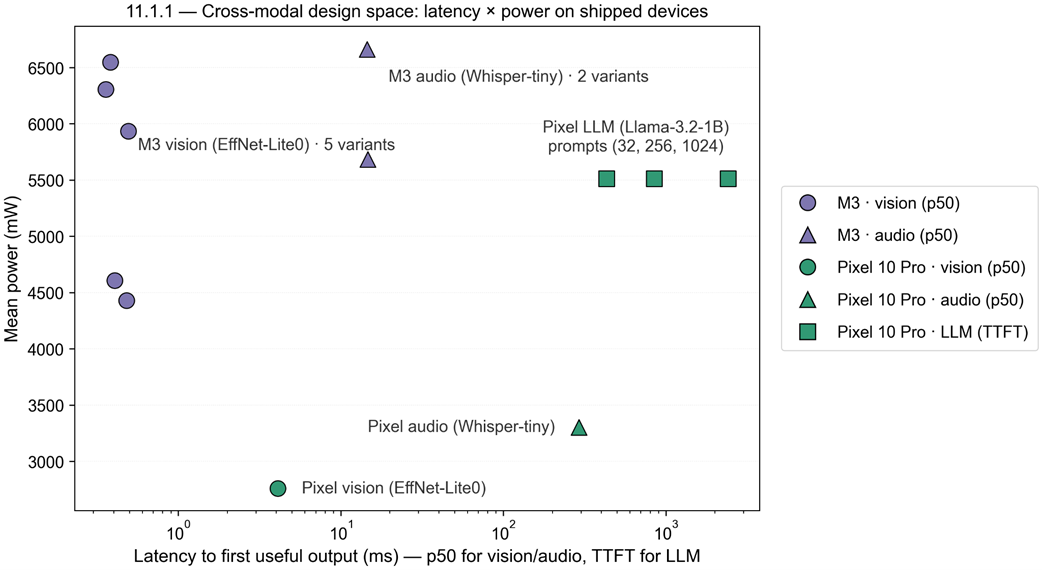
Compare measured latency and mean power across device and modality; readings use powermetrics on macOS and BatteryManager on Android over 30 seconds. section 11.1.1