liveBook · Manning

Mean scaling

As explained in Time Series Forecasting Using Foundation Models

Mean scaling is a data transformation that divides each value by the mean of the absolute values of all values in a series.

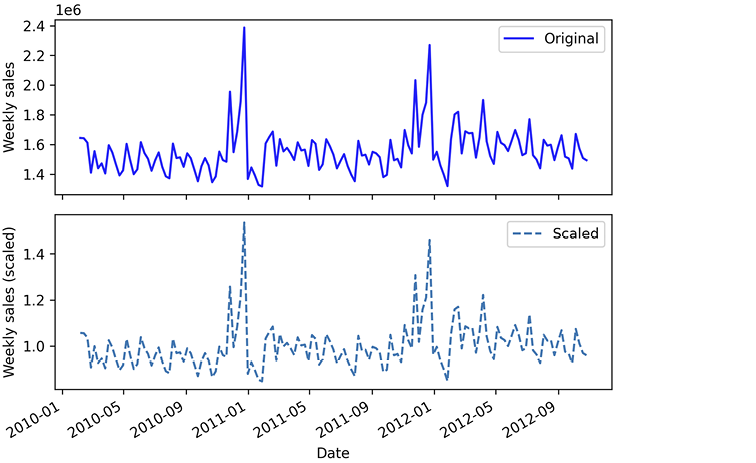
Mean scaling divides each time-series value by the mean of the absolute values of all values. It reduces scale while preserving the series’ overall pattern and meaningful zeros. section 5.3

Chronos uses mean scaling as the first tokenization step, before quantization maps continuous values into a finite token set. Predictions are later dequantized and unscaled. section 5.2 section 5.3

Consider these trade-offs when choosing the scaler:

  • Use mean scaling most cautiously for nonstationary data: trends can alter the mean and obscure local patterns. section 5.3
  • Replace it with another scaler when needed; Chronos allows this with minimal changes. section 5.3
Figure 5.3 Example of mean scaling. The data at the top is in its original scale, and the data at the bottom was mean-scaled. Notice that the general pattern stays the same. The difference lies in the range of values.
A screenshot of a graph

Description automatically generated

Compare original and mean-scaled series to see how the range shrinks while the general pattern remains. section 5.3

How Time Series Forecasting Using Foundation Models covers it

How deep it goes
Explains the transformation, rationale, visual effect, and stationarity limitation, but does not provide implementation code.
Examples
Uses weekly store sales and daily road traffic to motivate scale differences, plus a visual original-versus-scaled series comparison.
What you can do after
Apply mean scaling before quantization in a Chronos-style forecasting pipeline and judge when trends make it unsuitable.
How it connects
Connects mean scaling with time-series forecasting, tokenization, quantization, and language models.

Related concepts

This explainer was generated by Manning's knowledge graph from the text of Time Series Forecasting Using Foundation Models. The section links point to the parts of the book it draws on.