Meaning-making is the process of constructing and interpreting significance from language, signs, symbols, and abstractions. Semiotics provides a practical lens for seeing how people and language models organize these elements into meaningful output. section 2.1.2
The approach treats human-like language understanding in LLMs as mimicry rather than settled understanding. It therefore keeps both the usefulness and the limitations of generated meaning in view. section 2.1.2
A semiotic interpretation can be examined through:
- Signs, signifiers, and abstractions, which organize how significance is represented and processed. section 2.1.2
- Firstness, secondness, and thirdness, which mark stages or orientations in the sequence of processing meaning. section 2.1.2
- Feelings, images, encodings, words, tables, rituals, and common scripts, which connect perception with interpreted action. section 2.1.2
Figure 2.2 A recursive Peircean semiotic triangle is a system of organizing the process of extracting meaning from anything—in our case, from language. Each point on the triangle illustrates one of the minimal parts needed to synthesize meaning within whatever the system is being used to describe, so each point is a minimal unit in meaning for language. Firstness, secondness, and thirdness are not points on the triangle; instead, they are more like markers for the people versed in semiotics to be able to orient themselves in this diagram.
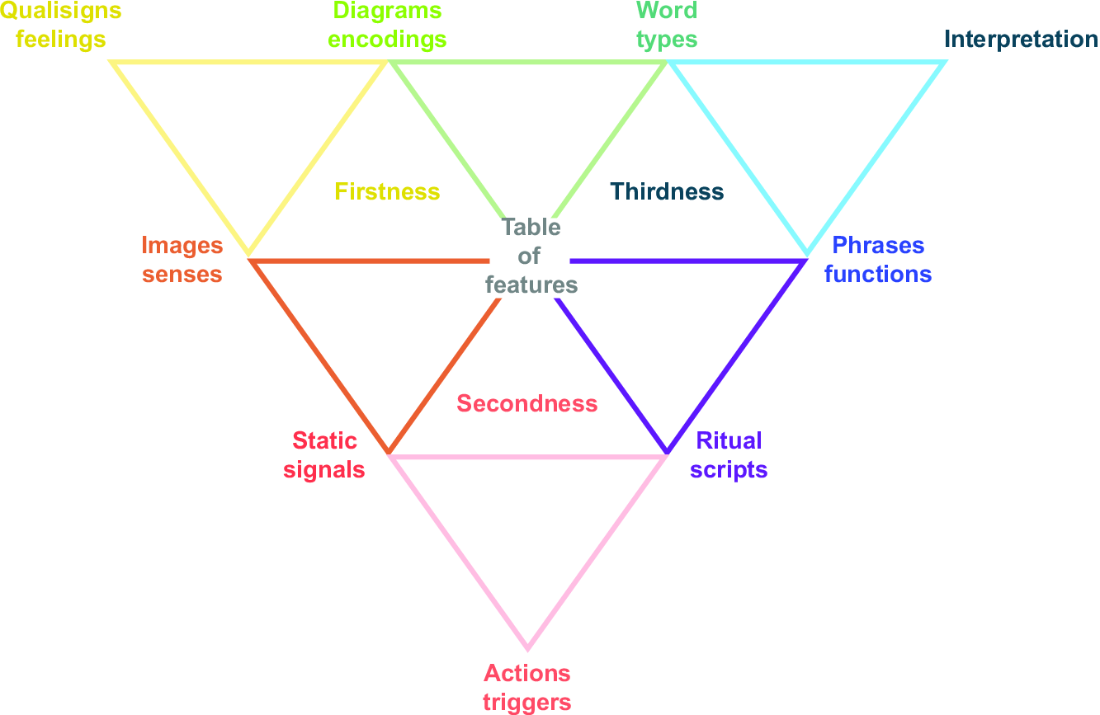
Use the recursive semiotic triangle to inspect the minimal parts involved in extracting meaning from language and their organization within the larger process. section 2.1.2
Figure 2.3 Starting at the top-left corner, follow the arrows to see the general order we use to build our interpretations and extract meaning from things we interact with. Here, we’ve replaced the descriptive words with some examples of each point. Try to imagine interpreting this diagram without any words, examples, arrows, or even the pragmatic context of knowing what a figure in a book like this is supposed to be for.
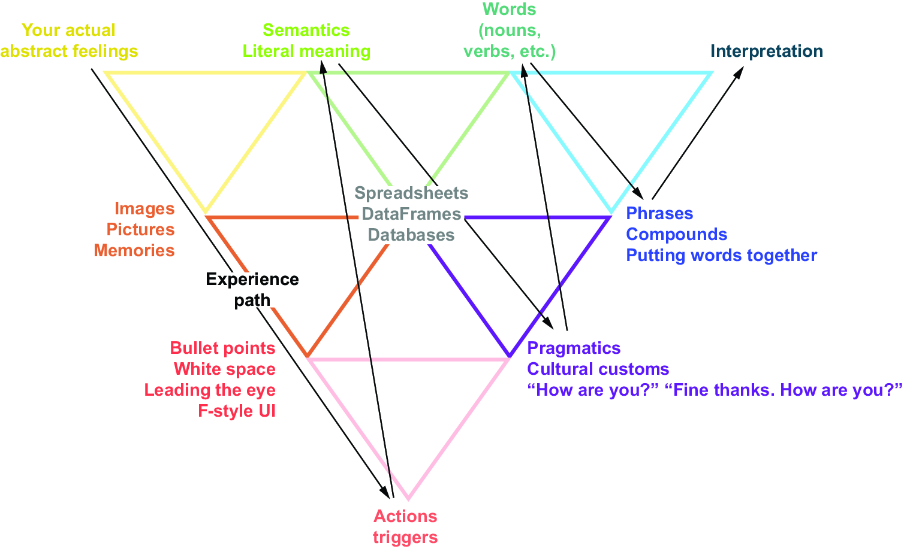
Follow the arrows to trace a general order for building interpretations, then compare how examples and pragmatic context guide the extraction of meaning. section 2.1.2
