A measurement basis is an orthogonal pair of quantum states, |m₀⟩ and |m₁⟩, assigned to measurement outcomes 0 and 1. Choosing the basis determines how information about an unknown qubit state becomes an observable result. section 4.4.1
For distinguishing two nonorthogonal states, a basis can be parameterized and evaluated as follows:
- Represent the input and basis states with angles: |ψ₁⟩ = cos(2θ)|0⟩ + sin(2θ)|1⟩, |m₀⟩ = sin(γ)|0⟩ − cos(γ)|1⟩, and |m₁⟩ = cos(γ)|0⟩ + sin(γ)|1⟩. section 4.4.1
- Use outcome 0 to guess |ψ₀⟩ and outcome 1 to guess |ψ₁⟩, then calculate correctness from squared overlaps. section 4.4.1
- For equally likely inputs, maximize P_success = ½[sin²(γ) + cos²(γ − 2θ)] by choosing γ. section 4.4.1
Minimum-error discrimination
Distinguish |ψ₀⟩ = |0⟩ from |ψ₁⟩ = ½|0⟩ + (√3/2)|1⟩. The state angle θ and basis angle γ describe how closely the orthogonal measurement states can align with the states being distinguished. section 4.4.1
Figure 4.6 Choosing the measurement basis for distinguishing \(\ket{\psi_0} = \ket{0}\) from \(\ket{\psi_1} = \frac12 \ket{0} + \frac{\sqrt3}{2} \ket{1}\) with minimum error. We can describe the state \(\ket{\psi_1}\) using only one parameter, the angle \(\theta\) (for this example, \(2\theta = \frac{\pi}{3}\)), and the measurement basis using the second parameter, the angle \(\gamma\). We want to choose the measurement basis states so that they are as close to the states being distinguished as possible while remaining orthogonal.
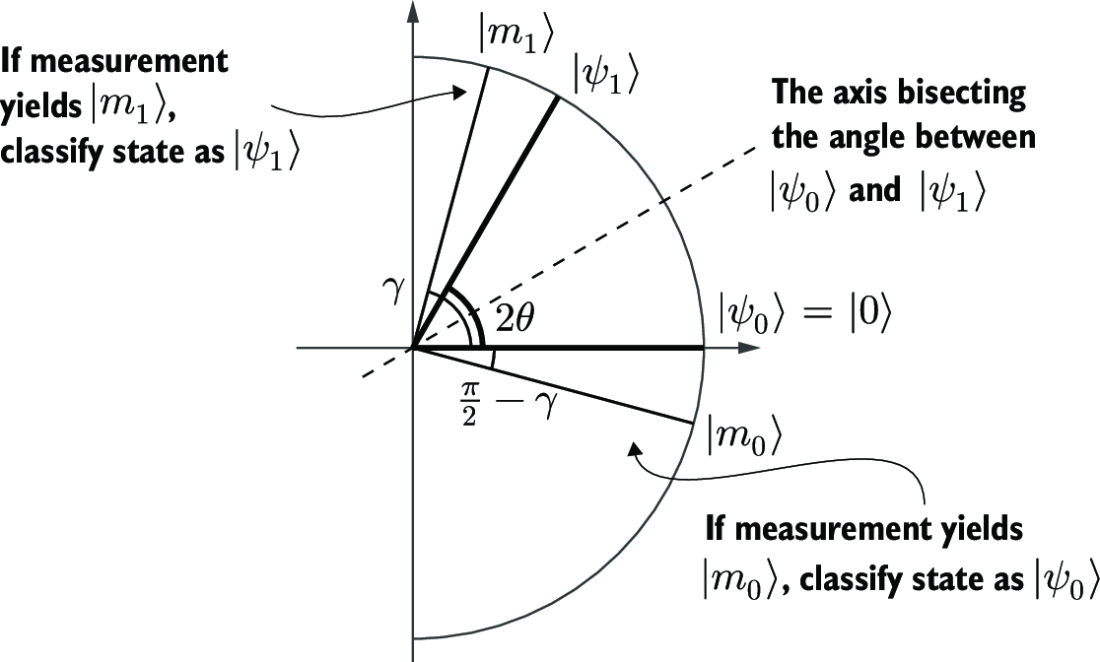
A geometric diagram shows the two input states and the orthogonal measurement pair on a unit circle, making the angle-based optimization concrete. section 4.4.1
