A membership grade expresses how strongly a data point belongs to a fuzzy cluster. Unlike hard clustering, fuzzy clustering allows one point to belong to multiple clusters, with stronger membership near a cluster center and weaker membership near its boundary. section 5.5
Interpret membership grades through these practical properties:
- FCM assigns a grade to every data point for each cluster; the grades are normalized between 0 and 1. section 5.5.1
- A grade is not necessarily a probability: summing a point’s degrees across clusters may not produce 1. section 5.5.1
- The partition matrix stores each value wᵢⱼ, representing the degree to which item i belongs to cluster j. section 5.5.1
- FCM calculates membership grades alongside cluster centroids and controls fuzziness with the hyperparameter m. section 5.5.1 section 5.9
Center versus boundary
Suppose customer transactions form two fuzzy clusters. A point close to the first cluster’s centroid receives a higher membership grade for that cluster than a point near its edge, while either point may also belong to another cluster. section 5.5.1
Figure 5.15 The figure on the left represents all the data points. The red points (those with an x in the print version) can belong to more than one cluster. In fact, we can allocate more than one cluster to each point. A probability score can be given for a point to belong to a particular cluster.
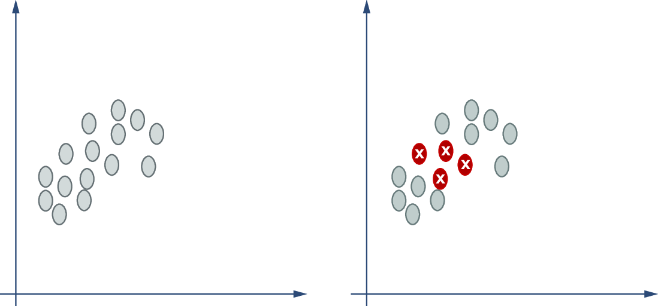
Use the diagram to compare overlapping cluster assignments and see how a point can receive a score for belonging to more than one cluster. section 5.5
