The memory layer retains what an agent learns across tasks. Its artifacts can be edited directly so useful lessons persist for later tasks, without changing the model itself. section 1.3.2 section 1.5
Memory artifacts include:
- Stored entries and recorded trajectories. section 1.3.2
- Learned values and records of tools or approaches that worked. section 1.3.2
- Skill files, which are text artifacts that memory can also store and retrieve. section 1.3.2
Improving memory means adding useful entries, correcting misleading ones, consolidating redundant ones, or strengthening those that have paid off. These edits put lessons within reach on subsequent tasks. section 1.3.2
Figure 1.8 The harness artifact layers of self-improvement. The frozen model (LLM) serves as the unchanging substrate below. The four artifact layers stacked on it are shared infrastructure, inherited by every instance of the agent. Layer zero is the toolkit, the engineering work that measures, searches, and applies, reused at every layer.
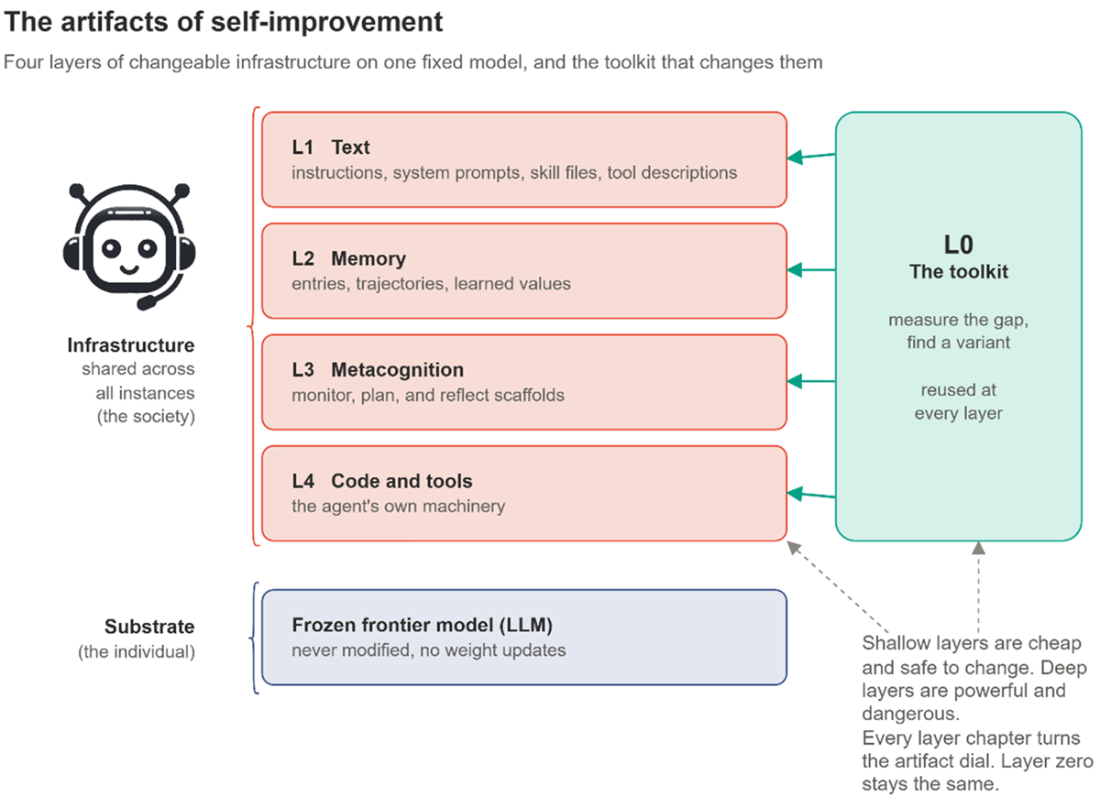
The diagram situates memory among the harness artifact layers, beneath the frozen model and alongside the other shared infrastructure. section 1.3.2 section 1.5