A memory-mapped register block is a set of hardware registers at fixed offsets from a peripheral’s base address. The processor accesses them with ordinary loads and stores, but unlike RAM, a register read or write can have hardware effects: a write might start a timer, while a read might return a status flag. section 5.1
On Cortex-M, most device peripherals occupy the Peripheral region. For example, STM32F103 GPIOA starts at 0x4001_0800 and USART1 at 0x4001_3800. Core peripherals such as SysTick and NVIC also have memory-mapped registers, in the System region. Check the device’s memory map for the correct base address and offsets. section 5.1 section 5.1.1
Figure 5.1 Registers' address offsets
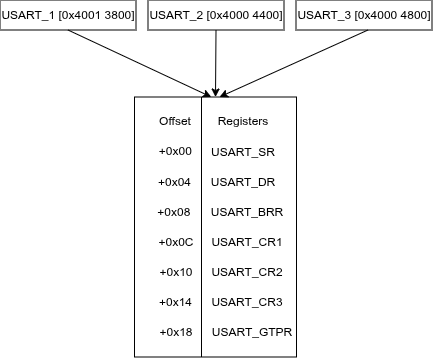
The register-offset diagram shows how registers are arranged relative to a peripheral’s base address. section 5.1
A Rust struct can model a block’s layout. Use #[repr(C)] to preserve declaration order under C layout rules, and verify that padding and field offsets match the hardware definition. The attribute can still permit tail padding and does not make accesses volatile. In this example, vcell::VolatileCell provides volatile register reads and writes through get and set. section 5.4.2
#[repr(C)]
pub struct UsartRegisters {
    // Status Register @ 0x00
    sr: vcell::VolatileCell<u32>,
    // Data Register @ 0x04
    dr: vcell::VolatileCell<u32>,
    // Baud Rate Register @ 0x08
    brr: vcell::VolatileCell<u32>,
    // Control Register 1 @ 0x0C
    cr1: vcell::VolatileCell<u32>,
    // Control Register 2 @ 0x10
    cr2: vcell::VolatileCell<u32>,
    // Control Register 3 @ 0x14
    cr3: vcell::VolatileCell<u32>,
    // Guard Time and Prescaler Register @ 0x18
    gtpr: vcell::VolatileCell<u32>,
}
This USART register struct pairs each 32-bit field with its documented offset. section 5.4.2
Alternatively, a peripheral access crate (PAC) provides typed handles to register blocks. With the STM32F103 PAC, Peripherals::take() obtains exclusive access to the device peripherals. Registers expose read, write, and modify methods: write overwrites a register, while modify reads it, changes selected fields, and writes it back. section 5.3.3
Reset a GPIO pin with a PAC
The call gpioc.bsrr().write(|w| w.br13().set_bit()) writes the BR13 bit to the dedicated set/reset register. It avoids a read-modify-write cycle, which can race with interrupts or other contexts. Use modify when other fields in a suitable register need to be preserved. section 5.3.3
Directly accessing an arbitrary register address in Rust requires unsafe code. The programmer must ensure the access is correct; a layout attribute alone does not provide volatile access or establish safety. section 5.2 section 5.4.2
