Imagine two threads sharing an object. One changes it; the other needs to know when that change is visible. A consistency model supplies rules for reasoning about that visibility. In C, timing between threads is expressed through the happens-before relation, established by synchronization using atomic objects or specific library functions. section 19.0 section 19.5
Figure 19.1. Two threads that synchronize via an atomic. The circles present the modifications of object x. The bars below the threads represent information about the state of A, and those above represent information about the state of B.
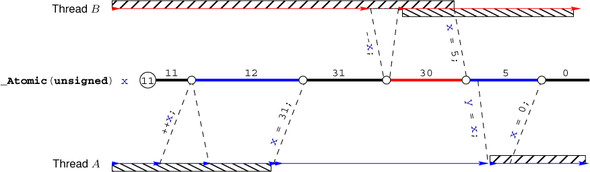
Follow the two threads and the modifications of the shared object. The bars depict what each thread knows about the other's state; synchronization is what makes cross-thread reasoning possible. section 19.0
TAKEAWAY: Sequential consistency is the default consistency model for atomics, not for other C library functions. It additionally assumes a total order of the corresponding synchronization events. That assumption can be expensive; explicit acquire-release consistency can be more efficient, but requires careful arguments to atomic functions with an _explicit suffix. section 19.5
Do not confuse this question with C's object-and-storage memory model. That model treats objects as byte representations accessible through typed pointers; it also constrains aliasing. A consistency model addresses how concurrent parts of an execution can reason about changes to shared state. section 12.0 section 12.3



