A Memory Protection Unit (MPU) enforces access permissions for configured memory regions in hardware. On Cortex-M, a no-access region below a stack can catch overflow when an offending read or write occurs. section 7.4.5
A stack guard depends on careful configuration:
- Align the guard address to the region size; the example uses a 32-byte region and requires 32-byte alignment. section 7.4.5
- The cortex-m crate exposes raw MPU registers, so configuration writes directly to CTRL, RNR, RBAR, and RASR. section 7.4.5
- A violation raises a memory management fault or hard fault; fault status registers identify the access type and address for post-mortem logging. section 7.4.5
- Plan the limited region budget across stack guards and other protections. The MPU complements flip-link, which catches overflow at the bottom of RAM. section 7.4.5 section 7.5
Figure 7.6 MPU stack guard: hardware-enforced overflow detection
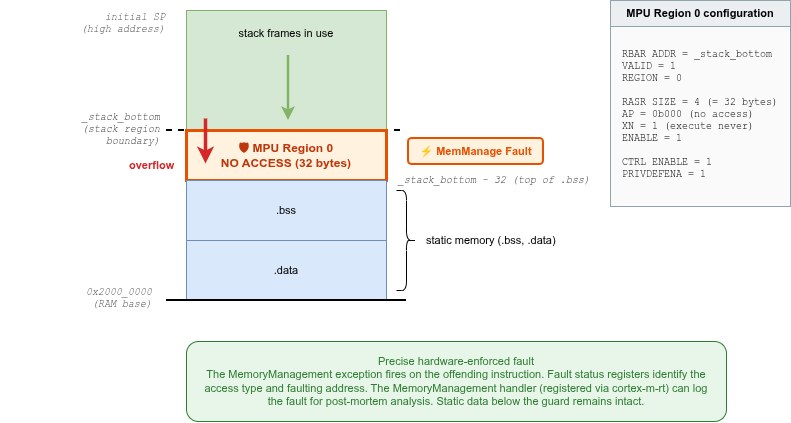
The diagram shows how a no-access region below the valid stack catches overflow. section 7.4.5
use cortex_m::peripheral::MPU;

/// Configure region 0 as a 32-byte no-access guard at `guard_addr`.
/// `guard_addr` must be 32-byte aligned.
fn install_stack_guard(mpu: &MPU, guard_addr: u32) {
    // RASR encoding for a 32-byte no-access execute-never region:
    //   bit  0       ENABLE = 1
    //   bits 5:1     SIZE   = 4  ->  region size = 2^(SIZE+1) = 32 bytes
    //   bits 26:24   AP     = 0b000  ->  no access from any privilege
    //   bit  28      XN     = 1  ->  execute never
    const RASR_ENABLE: u32 = 1 << 0;
    const RASR_SIZE_32: u32 = 4 << 1;
    const RASR_AP_NONE: u32 = 0b000 << 24;
    const RASR_XN: u32 = 1 << 28;

    // RBAR encoding:
    //   bits 31:5    ADDR   = base address (must be aligned to size)
    //   bit  4       VALID  = 1  ->  use REGION field below
    //   bits 3:0     REGION = 0  ->  configuring region 0
    const RBAR_VALID: u32 = 1 << 4;
    const RBAR_REGION_0: u32 = 0;

    // CTRL encoding:
    //   bit 0   ENABLE     = 1
    //   bit 2   PRIVDEFENA = 1  ->  default memory map active as background
    const CTRL_ENABLE: u32 = 1 << 0;
    const CTRL_PRIVDEFENA: u32 = 1 << 2;

    unsafe {
        // Disable the MPU while reconfiguring.
        mpu.ctrl.write(0);

        // Select region 0 and program its base and attributes.
        mpu.rbar.write(guard_addr | RBAR_VALID | RBAR_REGION_0);
        mpu.rasr.write(RASR_ENABLE | RASR_SIZE_32 | RASR_AP_NONE | RASR_XN);

        // Re-enable the MPU with the default memory map as background,
        // so unrelated regions keep their normal access rules.
        mpu.ctrl.write(CTRL_ENABLE | CTRL_PRIVDEFENA);

        // Ensure the MPU configuration is observed before any subsequent
        // memory access (covered in chapter 5).
        cortex_m::asm::dsb();
        cortex_m::asm::isb();
    }
}
The listing encodes a 32-byte no-access region through MPU registers. section 7.4.5
