A memory transaction is a unit of memory service. On a GPU, a warp issues a memory instruction together, and the hardware tries to serve its threads’ requests in as few transactions as possible. Fewer transactions mean fewer fetched bytes go unused. section 10.4
For 4-byte floats, the 128-byte cache-line teaching model makes the difference clear:
- When 32 warp threads request consecutive floats, one transaction can serve them all. section 10.4
- When threads request unrelated locations, the warp may need up to 32 transactions to fetch 32 floats. section 10.7
One delivery truck or many
Think of each transaction as a truck carrying a 32-slot container. If 32 threads request nearby data, one truck can serve them; if their requests are scattered, separate trips fetch mostly unused space. section 10.4
Figure 10.5 Scattered access: 32 threads, up to 32 transactions. The warp’s 32 threads (T0 … T31) each read from an unrelated location in memory, so their addresses fall into up to 32 different 128-byte cache lines (the brackets at indices 32*i, 32*j, 32*k, …). Because no two threads share a cache line, the hardware must issue a separate transaction for each one, and only 4 bytes out of every 128-byte transaction are actually used, roughly 3% bandwidth efficiency in this chapter’s cache-line model (about 12.5% counted in 32-byte sectors), the worst case in this chapter. Following the Snapshot Rule, picture 32 arrows fanning out to 32 different cache lines, each one carrying a single useful element.
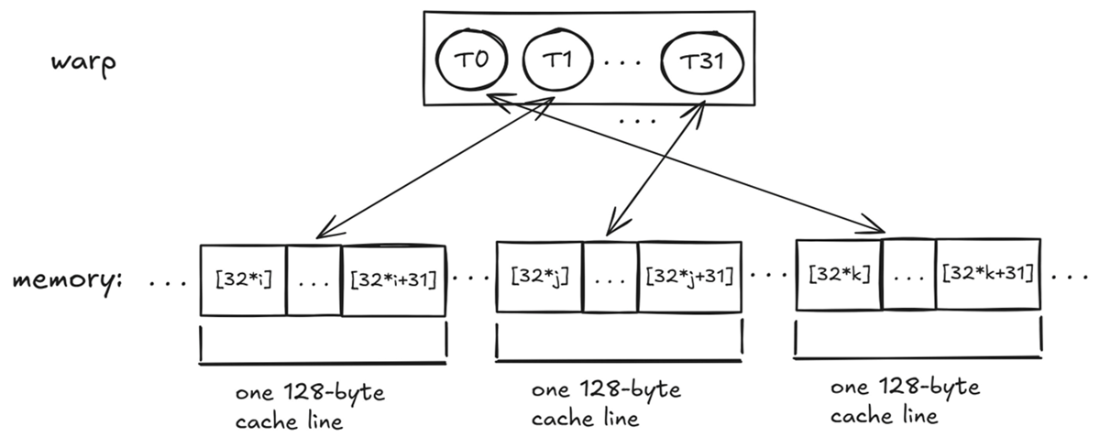
The figure shows how scattered warp requests can fan out across separate cache lines, wasting most of each transaction. section 10.7
