Merkle–Damgård is an iterative design for hash functions. It splits input into equal-length blocks, pads the final block, and feeds each block plus the previous state into a compression function. After the last block, the resulting state is the hash digest. section 6.3.1 section 6.5
Figure 6.5 The Merkle–Damgård construction for hash functions
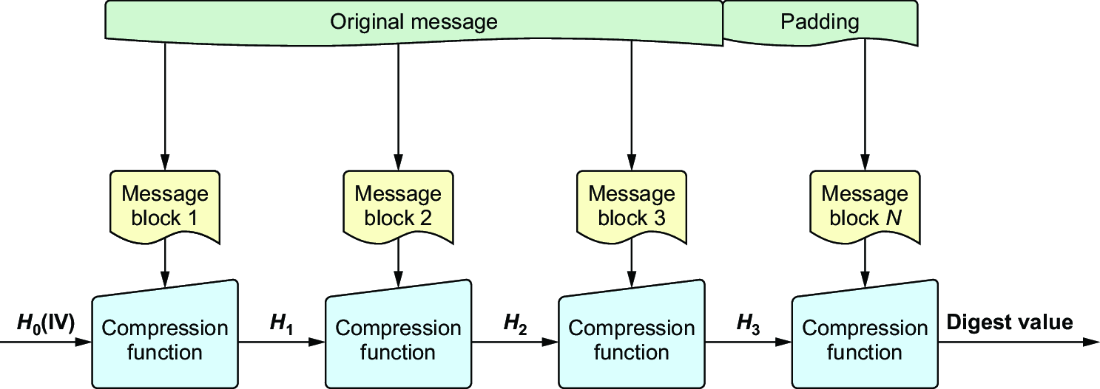
Follow the chaining value from one message block to the next: each compression step combines the current block with the prior state, producing the state for the next step. section 6.3.1
This design underlies MD5, SHA-1, and SHA-2. MD5 and SHA-1 have practical collision attacks that outperform brute-force birthday attacks; SHA-256 and SHA-512 remain collision-resistant as described here, but their construction still permits length extension. section 6.3 section 6.3.1
Its critical consequence is that the digest exposes the complete final internal state. Given H(A), an attacker can resume hashing and calculate a digest for A with appended data B without knowing A. Padding and the original message length let the resumed computation align with the original block sequence. section 7.3.2 section 6.5
Length-extending a secret-prefix MAC
A bank API authenticates a transaction as SHA-256(secret || parameters). An attacker who knows a valid request, its digest, and the original length can add padding and new parameters, initialize SHA-256 from the old digest, and produce a valid MAC for the extended request. Secret-prefix MACs built with Merkle–Damgård hashes are therefore unsafe against this attack. section 7.3 section 7.3.2
Figure 7.9 Because the internal state of the hash function is available to the attacker in the digest, the hash calculation can be “resumed.”
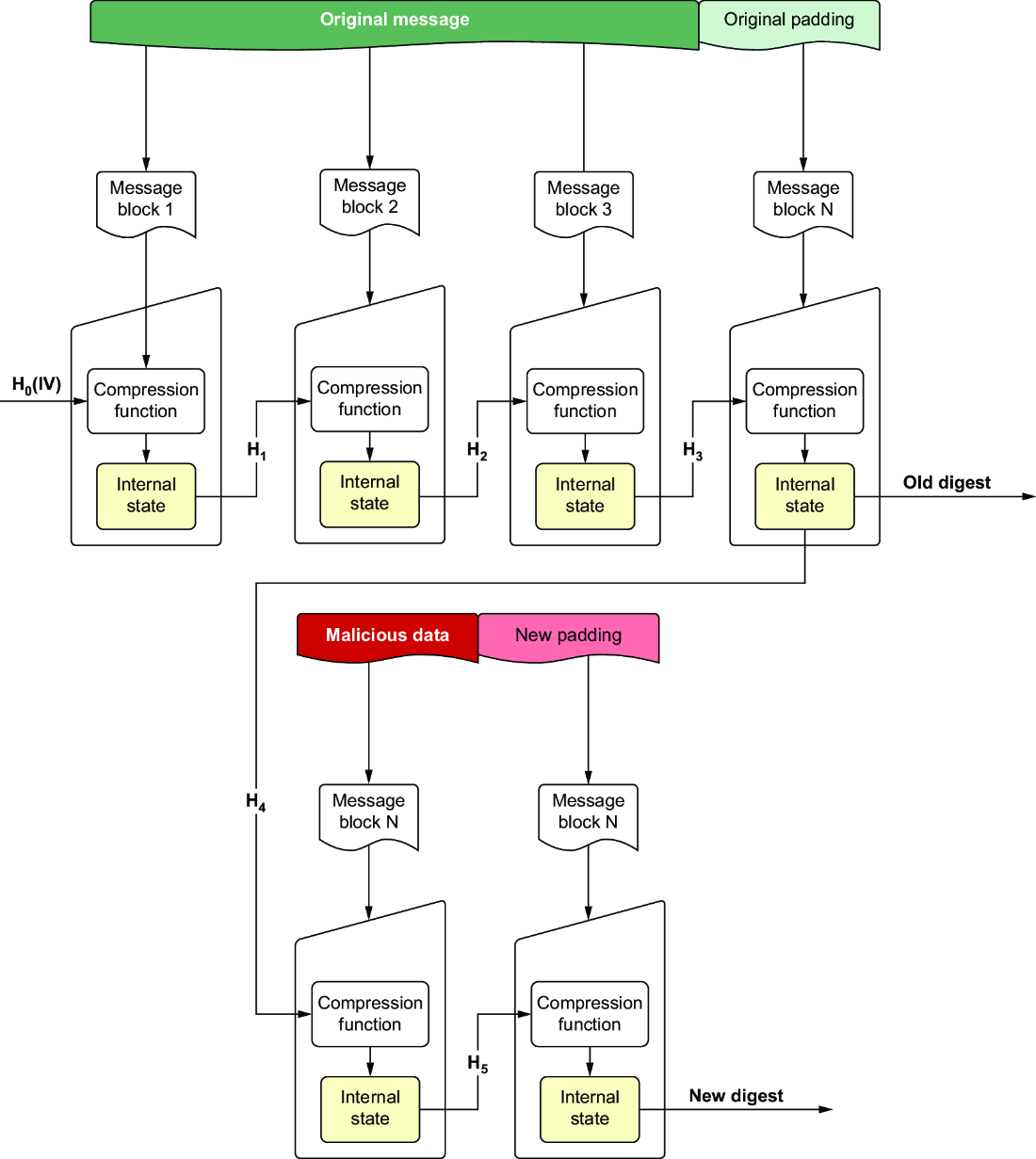
The diagram captures why extension works: the published digest is sufficient state to continue the block-by-block calculation with attacker-controlled input. section 7.3.2
For designs requiring resistance to this weakness, distinguish Merkle–Damgård hashes from SHA-3’s sponge construction: SHA-3 was standardized later and avoids the length-extension weakness associated with older designs. section 6.3 section 6.3.2

