liveBook · Manning

Request-response message exchange

As explained in Think Distributed Systems

Communication between distributed components in which messages are sent through a network.

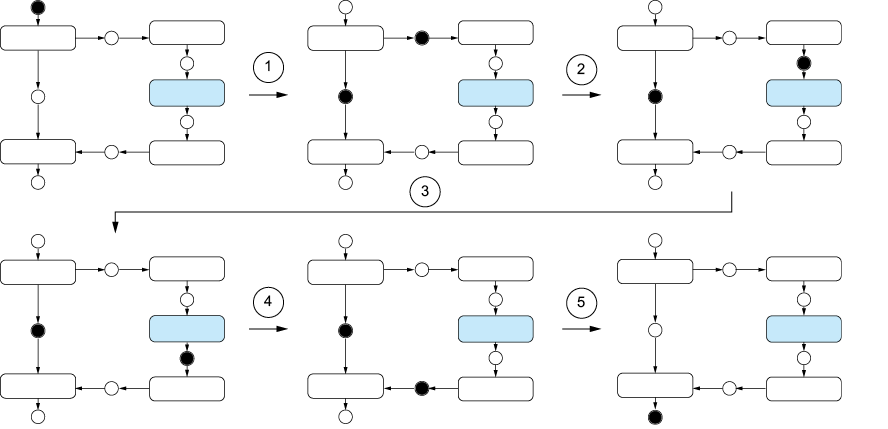
Request-response message exchange coordinates distributed components through a request, receiver-side processing, and a response. Processing may cause a side effect before the response returns. section 4.1

A useful mental model separates the dialogue into five steps: the sender submits a request, the network delivers it, the receiver processes it, the receiver submits a response, and the network delivers that response. section 4.1

Reason about two distinct reliability dimensions:

  • The network may reorder, drop, or duplicate messages; components may crash, recover, and forget volatile state while retaining durable state. section 4.1

Checkout as a multi-step exchange

An e-commerce checkout can involve charging a card, shipping goods, and issuing tickets. A failure must not leave an incorrect partial application: successful checkout should charge exactly once, while failed checkout should not charge at all. section 3.3.1

Figure 4.2 Step-by-step progression of the request-response dialogue
A diagram of a flowchart

AI-generated content may be incorrect.

Trace the request-response dialogue as a concrete sequence of network and component events. section 4.1

How Think Distributed Systems covers it

How deep it goes
Defines the dialogue, separates delivery from processing, and models failures, but defers recovery protocols and implementation mechanics.
Examples
Uses service orchestration diagrams, a step sequence, an e-commerce checkout, and delivery and processing classification tables.
What it assumes
Assumes basic distributed-component vocabulary while establishing network behavior, component failures, and partial execution explicitly.
What you can do after
Evaluate distributed interactions by tracing requests and responses separately from delivery and processing guarantees.
How it connects
Connects service orchestration, message delivery, message processing, distributed transactions, and local versus global system views.

Related concepts

This explainer was generated by Manning's knowledge graph from the text of Think Distributed Systems. The section links point to the parts of the book it draws on.