Messaging lets software components communicate by exchanging messages over channels. Sender and receiver business logic connect to the messaging infrastructure through ports and adapters. section 8.3.1
Messages have two parts:
- A header holds name-value metadata, potentially including a unique message ID and return address. section 8.3.1
- A body carries the data in text or binary form. Message kinds include documents, events, and commands. section 8.3.1
Domain event
An event can signal a change to a domain object, such as an Order or Customer. section 8.3.1
Figure 8.12 The business logic in the sender invokes a sending port interface, which is implemented by the message sender’s adapter. The message sender sends a message to a receiver via a message channel. The message channel is an abstraction of messaging infrastructure. A message handler adapter in the receiver is invoked to handle the message. It invokes the receiving port interface implemented by the receiver’s business logic.
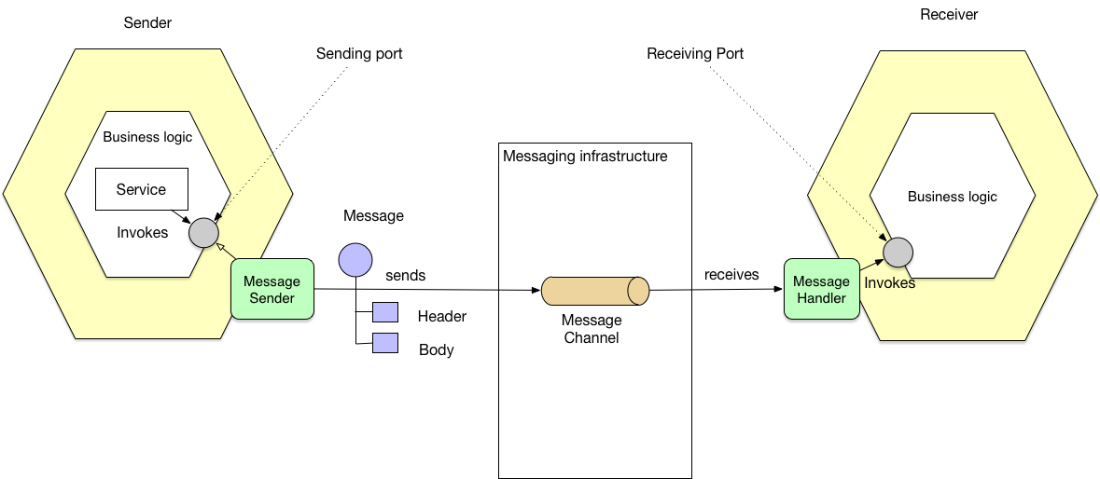
Trace how sender and receiver business logic connect to a channel through their ports and adapters. section 8.3.1