liveBook · Manning

Metacognition

As explained in Introduction to Generative AI, Second Edition

Metacognition is the capacity to recognize, monitor, or think about one's own mental processes.

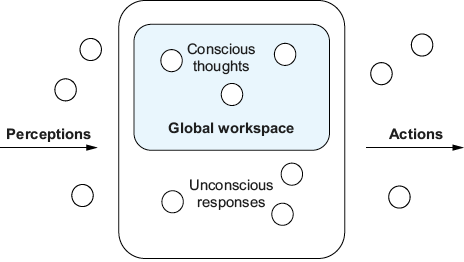
Metacognition means thinking about thinking: recognizing or becoming aware of one’s own mental processes. Conscious thoughts enter a shared mental workspace, while breathing or reflexes usually remain outside awareness. section 11.2

Whether artificial intelligence systems possess metacognition remains unsettled. Neurophysiological measures cannot prove the property even in humans, and no established metric shows that a large language model recognizes its own existence. section 11.2

Everyday awareness

Planning a work email while wondering about a recent date illustrates conscious thoughts held together in the workspace; noticing difficult breathing illustrates a normally unconscious process becoming salient. section 11.2

Figure 11.1 A diagram of the global workspace theory
A close-up of a card

AI-generated content may be incorrect.

A diagram of global workspace theory helps visualize how selected mental processes become available for conscious recognition. section 11.2


How Introduction to Generative AI, Second Edition covers it

How deep it goes
Defines metacognition through conscious awareness but stops short of providing a reliable measurement method.
Examples
Uses work-email planning, romantic uncertainty, breathing, knee-tap reflexes, and LaMDA’s self-description.
What you can do after
Evaluate claims about AI consciousness while distinguishing fluent responses from demonstrated self-awareness.
How it connects
Links metacognition with consciousness, global workspace theory, and large language models.

Also explained in

Compare how 2 books explain metacognition →

Related concepts

This explainer was generated by Manning's knowledge graph from the text of Introduction to Generative AI, Second Edition. The section links point to the parts of the book it draws on.