The metacognitive layer (L3) contains routines that shape how an agent reasons inside its harness: how it plans, monitors progress, and decides to stop or reconsider. Its artifacts are scaffolds, usually composed from prompts and memory references rather than built to stand alone. Improving L3 changes how the agent uses what it knows, not the model’s weights. section 1.3.2 section 1.5
An L3 change can adjust the agent’s reasoning routine by changing:
- When it decides to call a tool. section 1.3.2
- How many reasoning steps it allows before answering. section 1.3.2
- Which memories it consults at a given step. section 1.3.2
L3 sits between memory (L2) and code and tools (L4). Deeper changes can be more powerful and harder to undo; L4 is identified as the deepest layer and most in need of a human production gate. section 1.3.2 section 1.5
Figure 1.8 The harness artifact layers of self-improvement. The frozen model (LLM) serves as the unchanging substrate below. The four artifact layers stacked on it are shared infrastructure, inherited by every instance of the agent. Layer zero is the toolkit, the engineering work that measures, searches, and applies, reused at every layer.
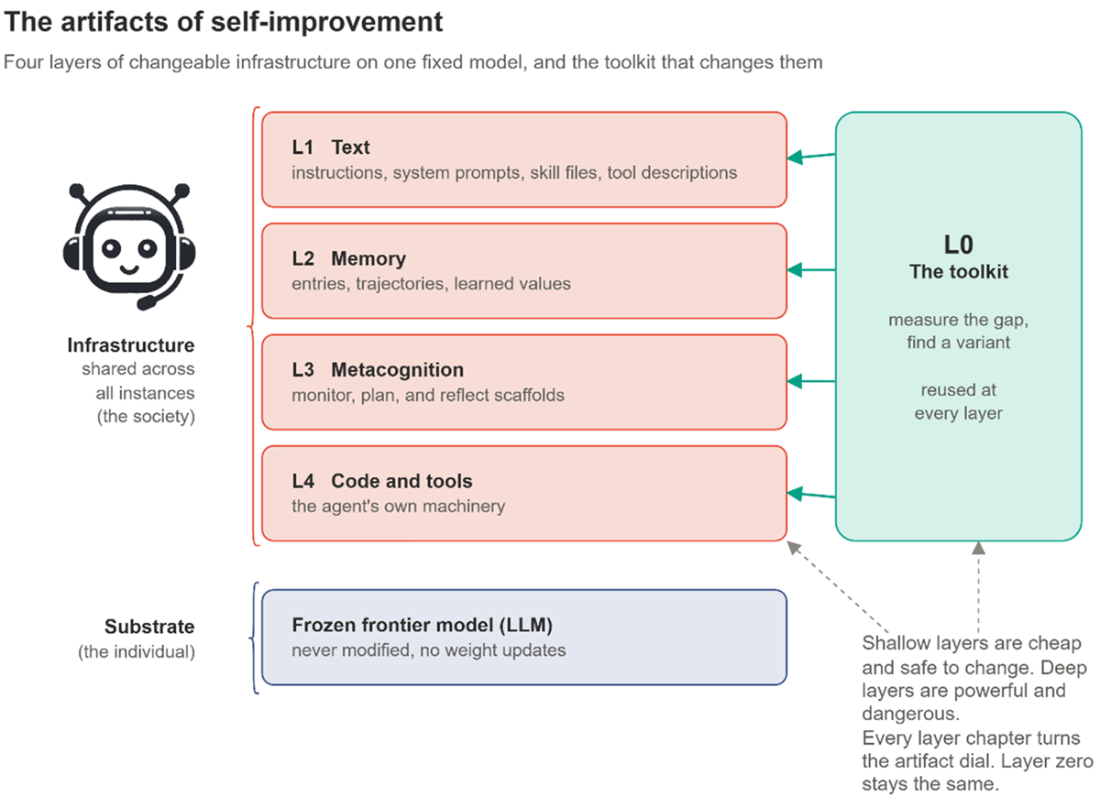
The layer diagram places L3 among the shared harness artifacts, above the frozen model and alongside the other artifact layers. section 1.3.2