liveBook · Manning

Metric multidimensional scaling

As explained in Data Without Labels

Metric multidimensional scaling is a form of multidimensional scaling that seeks a configuration whose distances preserve the numerical magnitudes of the input dissimilarities.

Metric multidimensional scaling reduces multidimensional data to fewer dimensions while preserving numerical dissimilarities through distances that can be transformed into Euclidean distances. section 6.2 section 6.2.2

A metric MDS workflow follows these ideas:

  • Calculate the distances between data points. section 6.2.2
  • Represent the higher-dimensional points in a lower-dimensional space. section 6.2 section 6.2.2
  • Optimize a loss or cost function to select an effective resultant dimensionality and configuration. section 6.2.2
  • Interpret stress as goodness of fit: 0.050 is good, 0.025 is excellent, and 0.000 is perfect in the supplied scale. section 6.2.2

Mapping distances

Distances between cities can be represented on a map to build intuition for MDS: the lower-dimensional arrangement aims to retain the relationships among locations, although an illustrative map is not an actual result. section 6.2

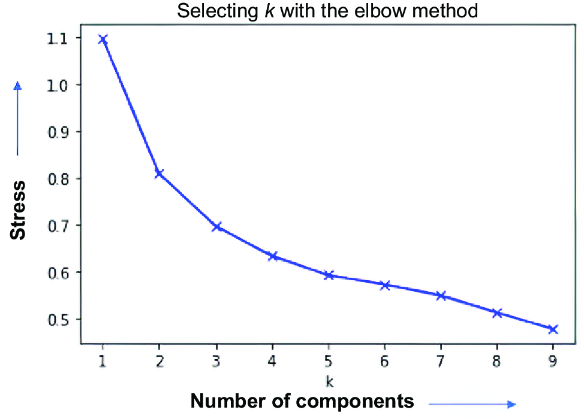
Figure 6.5 Scree plot to find the optimal number of components. It is similar to the k-means solution; we have to look for the elbow in the plot.
figure

Use the scree plot to look for an elbow when choosing the number of components. section 6.2.2

How Data Without Labels covers it

How deep it goes
Defines distance preservation and outlines calculation, representation, cost optimization, stress, and component selection without implementation details.
Examples
Uses city-distance maps, three points represented in three, two, and one dimensions, and scree plots for component selection.
What it assumes
Assumes familiarity with points, distances, dimensions, and Euclidean distance while distinguishing numerical distances from ranked dissimilarities.
What you can do after
Evaluate/understand lower-dimensional configurations using preserved distances, optimized cost, stress values, and component-selection plots.
How it connects
Connects metric MDS with classical MDS, nonmetric MDS, Euclidean distance, cost functions, gradient descent, and dimensionality reduction.

Related concepts

This explainer was generated by Manning's knowledge graph from the text of Data Without Labels. The section links point to the parts of the book it draws on.