Metropolis-Hastings sampling constructs a Markov chain whose stationary distribution matches a target distribution p(x), such as a posterior or density. From the current state x, it proposes x′ from q(x′|x), then accepts or rejects the proposal using an MH ratio that preserves detailed balance. section 2.6 section 2.9
The method proceeds by:
- Selecting a target distribution p(x) and a proposal distribution q(x′|x). section 2.6
- Proposing a new state x′ conditional on the current state x. section 2.6
- Computing the MH ratio, derived as the correction required for detailed balance. section 2.6
- Accepting x′ with probability r(x′|x), or retaining the current state with probability 1 − r(x′|x). section 2.6
Sampling a Gaussian mixture
A from-scratch implementation defines target_pdf, proposal_pdf, and sample methods in an mh_gauss class. It samples a multivariate Gaussian-mixture target using a multivariate normal proposal, producing samples resembling two two-dimensional Gaussian components with means [4,0] and [−4,0], covariances [[2,1],[1,1]] and [[1,0],[0,1]], and mixture proportions [0.4,0.6]. section 2.6
Figure 2.13 Metropolis-Hastings pseudo-code
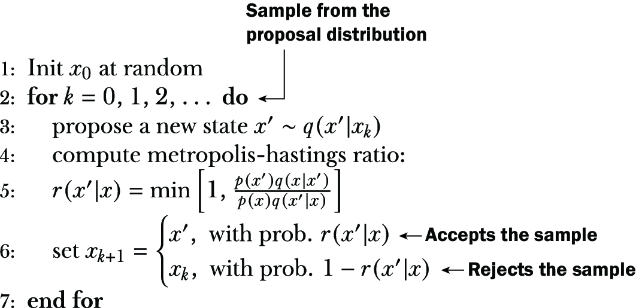
Use the pseudocode to follow the proposal, ratio, acceptance, and rejection loop. section 2.6
Listing 2.5 Metropolis-Hastings sampling
import numpy as np
import matplotlib.pyplot as plt

from scipy.stats import uniform
from scipy.stats import multivariate_normal

np.random.seed(42)

class mh_gauss:

    def __init__(self, dim, K, num_samples, target_mu, target_sigma,
     target_pi, proposal_mu, proposal_sigma):
     self.dim = dim
     self.K = K     #1
     self.num_samples = num_samples    #1
     self.target_mu = target_mu        #1
     self.target_sigma = target_sigma   #1
     self.target_pi = target_pi        #1

     self.proposal_mu = proposal_mu        #1
     self.proposal_sigma = proposal_sigma #2

     self.n_accept = 0
     self.alpha = np.zeros(self.num_samples)    #3
     self.mh_samples = np.zeros((self.num_samples,  #3
      self.dim))                                  #3

 def target_pdf(self, x):
     prob = 0
     for k in range(self.K):     #4
         prob += self.target_pi[k]*\ #4
             multivariate_normal.pdf(x,self #4
              .target_mu[:,k],self.target_sigma[:,:,k])     #4
     #end for                                                 #4
     return prob #4

 def proposal_pdf(self, x):
        return multivariate_normal.pdf(x, self
         .proposal_mu, self.proposal_sigma)     #5

 def sample(self):
     x_init = multivariate_normal
      .rvs(self.proposal_mu, self.proposal_sigma, 1)   #6
     self.mh_samples[0,:] = x_init

     for i in range(self.num_samples-1):
         x_curr = self.mh_samples[i,:]
         x_new = multivariate_normal.rvs(x_curr, self
          .proposal_sigma, 1)

         self.alpha[i] = self.proposal_pdf(x_new) /
          self.proposal_pdf(x_curr)     #7
         self.alpha[i] = self.alpha[i] *  #7
          (self.target_pdf(x_new)/self.target_pdf(x_curr))    #7

         r = min(1, self.alpha[i])    #8
         u = uniform.rvs(loc=0, scale=1, size=1)
         if (u <= r):
             self.n_accept += 1
             self.mh_samples[i+1,:] = x_new   #9
         else:
             self.mh_samples[i+1,:] = x_curr  #10
     #end for
     print("MH acceptance ratio: ", self.n_accept/float(self.num_samples))

if __name__ == "__main__":


    dim = 2
    K = 2
    num_samples = 5000
    target_mu = np.zeros((dim, K))
    target_mu[:,0] = [4,0]
    target_mu[:,1] = [-4,0]
    target_sigma = np.zeros((dim, dim, K))
    target_sigma[:,:,0] = [[2,1],[1,1]]
    target_sigma[:,:,1] = [[1,0],[0,1]]
    target_pi = np.array([0.4, 0.6])

    proposal_mu = np.zeros((dim,1)).flatten()
    proposal_sigma = 10*np.eye(dim)


    mhg = mh_gauss(dim, K, num_samples, target_mu, target_sigma, target_pi,
     proposal_mu, proposal_sigma)
    mhg.sample()

    plt.figure()
    plt.scatter(mhg.mh_samples[:,0], mhg.mh_samples[:,1], label='MH samples')
    plt.grid(True); plt.legend()
    plt.title("Metropolis-Hastings Sampling of 2D Gaussian Mixture")
    plt.xlabel("X1"); plt.ylabel("X2")
    plt.show()
Use the implementation listing to inspect target evaluation, proposal evaluation, sampling, and acceptance tracking. section 2.6

