liveBook · Manning

Microcontroller

As explained in Embedded Software with Rust

A microcontroller is an integrated computing device that combines a processor, memory, and peripherals for dedicated embedded control tasks.

A microcontroller combines a processor core with on-chip flash, SRAM, and peripherals to run embedded firmware. These devices operate under tight resource budgets, often without an operating system. section 1.1 section 1.5.1

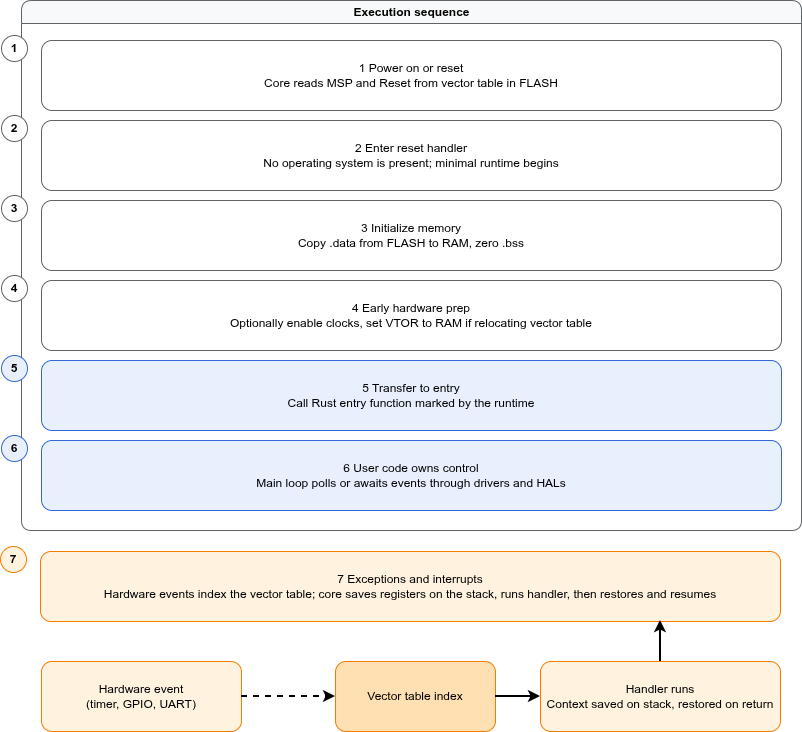
At power-on or reset, the hardware reads values that initialize the stack pointer and identify the reset handler, then transfers control to that handler. This predictable sequence happens before user code runs. section 1.2.1 section 1.2

Embedded Rust targets practical constraints of microcontroller firmware:

  • Memory safety without runtime overhead helps meet resource and predictable-timing constraints. section 1.1
  • Arm Cortex-M is the primary platform; selected RISC-V examples show portability and architectural contrasts. section 1.5 section 1.5.1
Figure 1.2 Initialization sequence
CH01 F02 Cabanis

Visualizes the initialization sequence from microcontroller power-on toward program execution. section 1.2

How Embedded Software with Rust covers it

How deep it goes
Explains stack-pointer initialization and reset-handler transfer, while deferring detailed memory layout and peripheral initialization.
Examples
Uses Arm Cortex-M as the default platform and selected RISC-V examples to illustrate portability and architectural contrasts.
What you can do after
Build minimal no_std firmware, configure startup and memory, and use safe peripheral drivers and HAL abstractions.
How it connects
Connects microcontrollers to embedded Rust, bare-metal execution, memory layout, startup flows, peripherals, and interrupt handling.

Related concepts

This explainer was generated by Manning's knowledge graph from the text of Embedded Software with Rust. The section links point to the parts of the book it draws on.