liveBook · Manning

MiniLM

As explained in The Art of AI Product Development

MiniLM is a compact transformer-based language-model family designed to provide efficient language understanding and representation.

MiniLM is a compact transformer-based language-model family used as an embedding model for semantic search. Its pretrained representations can miss domain-specific terminology, making fine-tuning valuable for specialized retrieval. section 7.2.4

Adapting retrieval to industry language

Fine-tuning MiniLM on internal reports, case studies, and client whitepapers helps a search system associate terms such as “ROI” and “cost-efficiency,” improving results for specialized users. Lexical search can still be added when exact phrases or endpoints matter. section 7.2.4

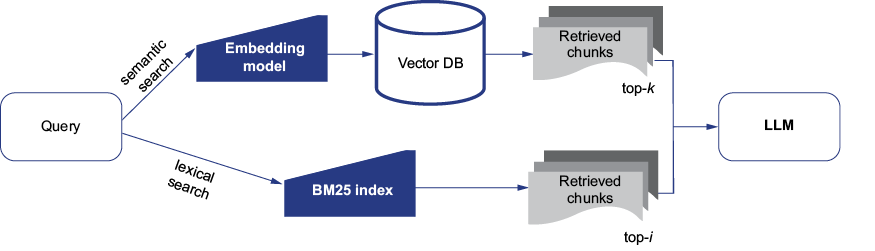
Figure 7.8 Combining semantic and lexical search can increase overall retrieval accuracy.
A diagram of a diagram

AI-generated content may be incorrect.

Use this figure to place MiniLM-based semantic retrieval within a broader system that also uses lexical search for exact matches. section 7.2.4

How The Art of AI Product Development covers it

How deep it goes
Explains domain-specific fine-tuning and retrieval effects but does not detail MiniLM’s architecture or training procedure.
Examples
Uses internal reports, whitepapers, ROI terminology, product-taxonomy phrases, and API endpoints as retrieval examples.
What you can do after
Apply it via fine-tuning on proprietary documents to improve relevance for specialized search users.
How it connects
Connects embeddings with semantic search, lexical search, fine-tuning, and retrieval-augmented generation.

Related concepts

This explainer was generated by Manning's knowledge graph from the text of The Art of AI Product Development. The section links point to the parts of the book it draws on.