A minimal d-separating set blocks every d-connecting path between two nodes while avoiding unnecessary members: removing any relevant member would fail to preserve the separation. Larger valid sets may contain a minimal set, but algorithms should focus on the minimal alternatives. section 4.2.1
Find candidate sets by checking paths and the effect of colliders:
- Enumerate the d-connecting paths between the target nodes. section 4.2.2
- Block ordinary path nodes, remembering that conditioning on a collider can open a path that was previously d-separated. section 4.2.1
- Retain only sets for which no relevant member can be removed without reopening a path. section 4.2.1
A collider can require an extra blocker
For U and V, M blocks U ← M → V and the other listed d-connecting paths. But conditioning on M opens U ← I → M ← J → V, so either I or J must also be included. The minimal sets are {I, M} and {J, M}. section 4.2.2
Figure 4.15 Blocking with M will block the path U ← M → V but would d-connect the path U ← I → M ← J → V because M is a collider between I and J. So we need to additionally block on either I or J to d-separate U ← I → M ← J → V.
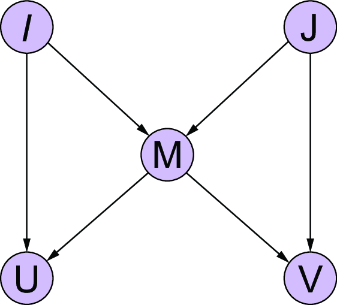
Inspect the path diagram showing why blocking at collider M requires an additional blocker at I or J. section 4.2.2
