A global optimum is the best feasible candidate across the entire search space: it has the best objective-function value among all candidates. In minimization, it is the point with the lowest value. section 1.3
Figure 1.3 Feasible solutions fall within the constraints of the problem. A feasible search space may display a combination of global, strong local, and weak local minima.
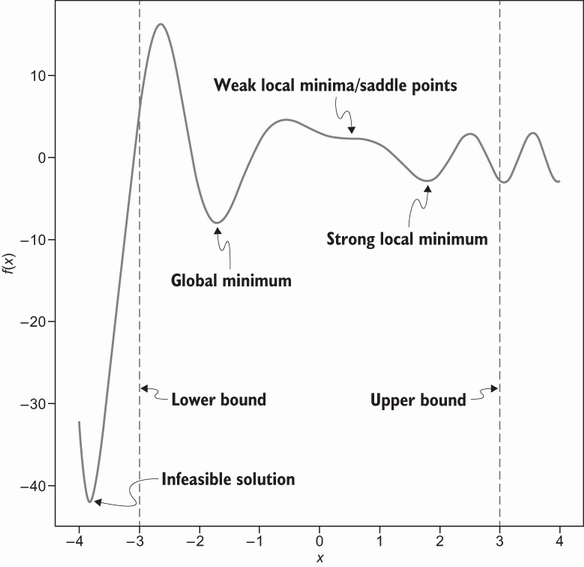
Use the feasible-search-space figure to distinguish a global optimum from strong and weak local minima. section 1.3
Separate global optimality from nearby or merely acceptable solutions:
- A feasible solution satisfies every constraint; an optimal solution is feasible and provides the best objective value. section 1.3
- A local optimum may be best in its neighborhood while remaining worse than the global optimum elsewhere. section 1.3
- Explorative search improves the chance of reaching global optima but can require impractical processing time; exploitative search is faster but may get trapped locally. section 1.5
Search strategy
A local search can settle on a nearby local minimum in a multimodal landscape. Random or strongly explorative search examines more of the space and therefore has a better chance of finding the global optimum, at higher computational cost. section 1.5
Figure 1.10 Search dilemma—there is always a trade-off between branching out to new areas of the search space or focusing on an area with known good or elite solutions.
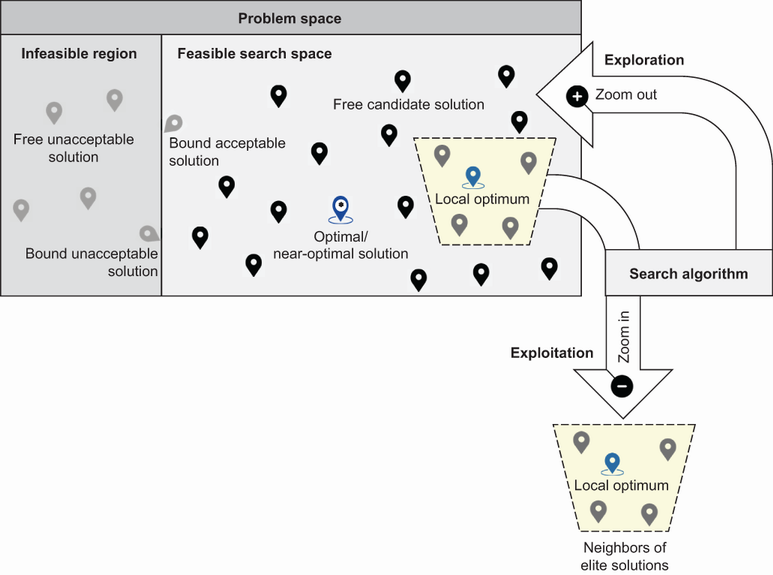
Use the search-dilemma figure to compare branching into unvisited regions with exploiting known elite solutions. section 1.5