A minimum energy state is the stable end state of annealing in which neither improving nor worsening moves are accepted. In physical materials, aligned molecules form this low-energy structure; in simulated annealing, the objective-function minimum represents it. section 5.2.1 section 5.2.4
From cooled glass to optimization
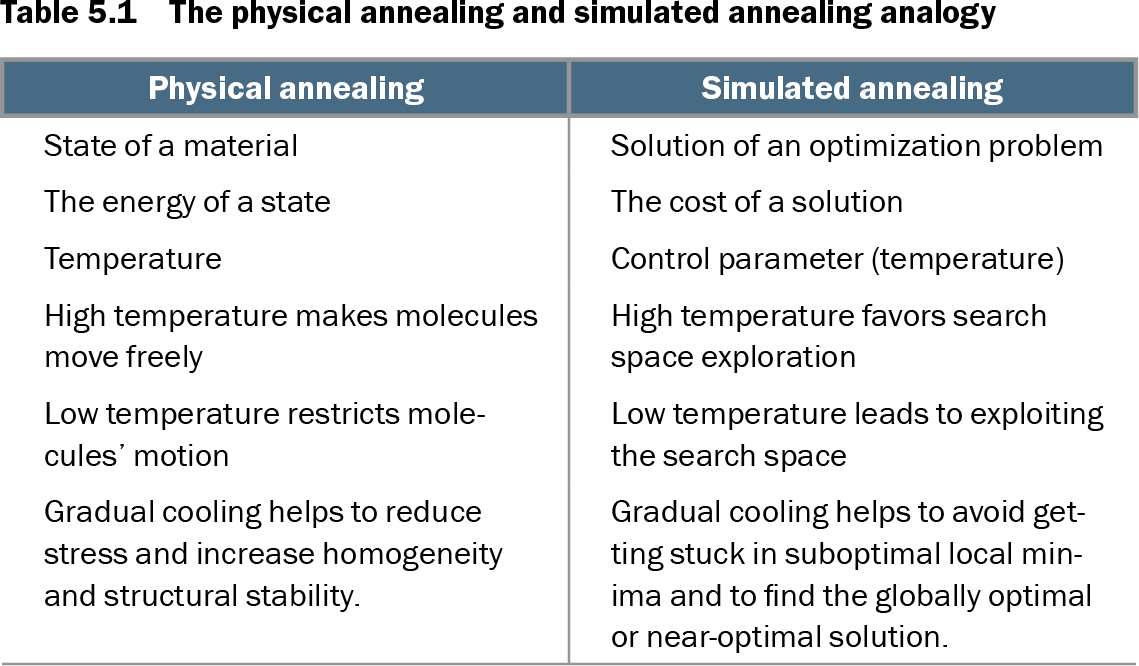
Slowly cooling a material lets molecules align into a crystalline structure. Simulated annealing borrows this analogy: gradual cooling shifts the search from exploration toward exploitation and can avoid suboptimal local minima. The process can stop when the temperature is suitably low or when the system reaches its frozen minimum-energy state. section 5.2.1 section 5.2.4
Table 5.1 The physical annealing and simulated annealing analogy (view table figure)
| Physical annealing |
Simulated annealing |
|---|---|
| State of a material |
Solution of an optimization problem |
| The energy of a state |
The cost of a solution |
| Temperature |
Control parameter (temperature) |
| High temperature makes molecules move freely |
High temperature favors search space exploration |
| Low temperature restricts molecules’ motion |
Low temperature leads to exploiting the search space |
| Gradual cooling helps to reduce stress and increase homogeneity and structural stability. |
Gradual cooling helps to avoid getting stuck in suboptimal local minima and to find the globally optimal or near-optimal solution. |
Use the physical-to-simulated annealing analogy to connect material state, energy, temperature, solution cost, exploration, and exploitation. section 5.2.1