liveBook · Manning

Minpoints

As explained in Data Without Labels

minPts is the minimum number of points required within a DBSCAN neighborhood to qualify as a dense region.

minPts sets the minimum number of points inside a point’s ε-neighborhood, including the point itself, required to identify a dense region in DBSCAN. section 2.5.2

A point with at least minPts neighbors within ε becomes a core point; changing minPts alongside ε fine-tunes cluster density and membership. section 2.5.2

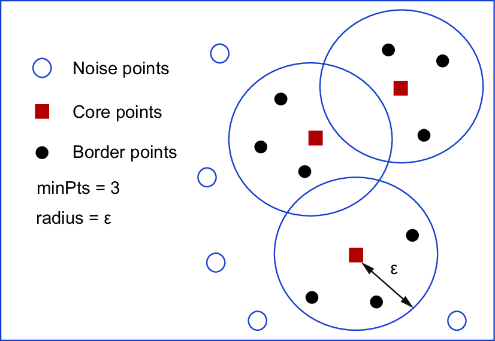
Figure 2.29 Core points are shown as squares; border points are shown as filled circles, while noise is unfilled circles. Together, these three are the building blocks for DBSCAN clustering.
figure

Compare core points, border points, and noise to see the categories created by DBSCAN’s density threshold. section 2.5.2

How Data Without Labels covers it

How deep it goes
Defines neighborhood counting and core-point classification, then connects threshold changes to cluster fine-tuning.
Examples
Uses a diagram of core, border, and noise points and scikit-learn configurations with min_samples values of 6 and 5.
What it assumes
Assumes DBSCAN and ε-neighborhoods, while defining minPts and point categories directly.
What you can do after
Apply it via scikit-learn’s DBSCAN by supplying min_samples alongside eps and inspecting resulting cluster labels.
How it connects
Connects DBSCAN with ε-neighborhoods, core points, border points, outliers, and density-based clustering.

Related concepts

This explainer was generated by Manning's knowledge graph from the text of Data Without Labels. The section links point to the parts of the book it draws on.